Business templates made for real service businesses.
Starting a Cleaning Business · United States
How to Start a Cleaning Business With No Experience
Start with a service you can deliver safely, a price that pays for your time, and a clear process for your first client.
The direct answer
Yes, you can start a cleaning business without previous professional cleaning experience. But you should not take paid jobs before you can perform the agreed work safely and consistently, meet applicable business requirements, and explain your scope and price. Begin with manageable residential services, practice deliberately, and expand only when your skills and numbers support it.
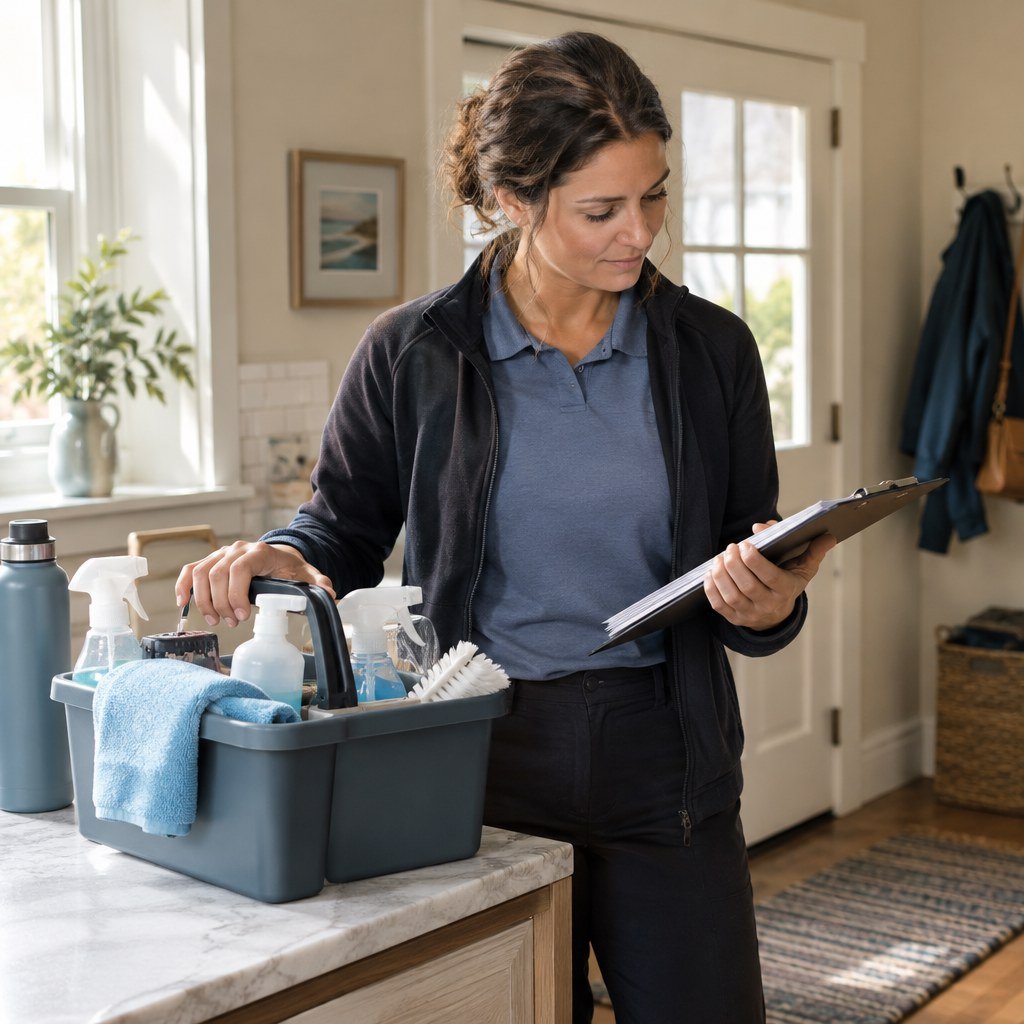
Your first cleaning business does not need to look like a large company. It needs to make a small number of promises you can keep: what you will clean, when you will arrive, what the visit costs, and what happens if the home needs more work than expected.
The difficult part is not buying supplies. It is learning to judge a job before you accept it, protect the customer’s property, and charge enough that a busy week is worth having.
This guide is for small, independent residential cleaners. The budgets and customer examples help you make decisions; they do not predict your income. Check the rules that apply where you work before you launch.
- Start narrower than your ambition. A clear service and compact service area are easier to test than an unlimited cleaning menu.
- Keep cash available. Equipment does not pay an insurance renewal or cover a slow week.
- Price all your working time. Travel, preparation, laundry, estimates and follow-up do not disappear because clients only see the cleaning.
- Write down the agreement. A shared scope prevents more confusion than a polished logo.
In this guide
Choose a cleaning service you can deliver reliably
“Residential cleaning” is a market, not a complete service description. Decide what is included, what costs extra, and what you will not do. A maintenance visit in a routinely cleaned home is different from removing months of kitchen buildup.
If you want a practical starting point for turning that scope into a client-facing offer, the Cleaning Service Menu & Quote Kit is designed for that focused part of the workflow.
| Service | Work and customer expectations | Beginner planning implications |
|---|---|---|
| Standard residential | Agreed routine tasks in kitchens, bathrooms and living areas; recurring daytime appointments may be possible. | A basic kit may suit the scope. Still assess surfaces, condition, pets and access. Define what “standard” excludes. |
| Deep cleaning | More detailed work and buildup removal; customers may expect tasks you consider extras. | Greater time uncertainty and surface-care demands. Add only tasks you can assess and perform safely. |
| Move-in / move-out | Empty-property work, possible appliance interiors and fixed handover deadlines. | Confirm utilities, access, debris and actual condition. Do not guarantee a landlord’s deposit decision. |
| Commercial comparison | Offices and other business premises; after-hours access and site-specific requirements may apply. | Security, procurement and equipment needs can differ. Medical or specialist sites are not equivalent to ordinary offices. |
Editorial comparison, not a national cost or training standard. Requirements depend on the actual premises and work.
Your decision test: can you explain the result, identify the surfaces, estimate the time, access the right equipment and obtain suitable insurance? If one answer is missing, investigate before adding the service. Decline hazardous remediation or specialist work outside your competence.
Build a startup budget that leaves you room to operate
Can you start a cleaning business with no money?
You can begin planning without spending, but a paid cleaning service needs its essential costs covered before the first job. If you already own suitable equipment and have reliable transport, your remaining cash need may be lower. That is different from a cost-free launch.
- Do now: choose a narrow service, practice suitable tasks, ask potential customers what they need and collect actual setup and insurance quotes. Use a free inquiry checklist to organize the first conversations.
- Fund before launch: the requirements that apply to your business, suitable insurance, safe equipment and supplies, transport and enough operating cash to complete the jobs you accept.
- Let these wait: paid advertising, premium branding, duplicate equipment and a large template collection. Buy an upgrade when a confirmed need and your cash position justify it.
The $500, $1,000 and $3,000 examples below show different assumptions, not three guaranteed entry prices. If your essential costs do not fit, postpone paid bookings and build the missing skills or funds. Do not rely on an unconfirmed future booking to pay for something the first job already requires.
There is no magic number for getting started. Your cash need comes down to what you already own, your setup costs, insurance, transport and the service you plan to offer. Build from real quotes, not someone else’s shopping list.
Separate money spent before opening from money needed after opening. A vacuum is a purchase. Fuel, replenishment and insurance payments continue. Personal living expenses also need a separate plan while bookings are uncertain.
| Allocation | Lean | Moderate | More equipped |
|---|---|---|---|
| Equipment | $120 | $250 | $650 |
| Insurance and setup, initially due | $180 | $300 | $600 |
| Supplies and protective items | $70 | $120 | $180 |
| Initial marketing | $20 | $80 | $120 |
| Working cash reserve | $110 | $250 | $1,450 |
| Total | $500 | $1,000 | $3,000 |
Conditions behind these examples: you work alone, already have reliable transport and a phone, and do not rent premises or buy a vehicle. The $500 scenario also assumes you already own a suitable, serviceable vacuum and can meet your actual setup and initial insurance costs within $180. None of these amounts is an insurance quote or an annual premium estimate.
The reserve covers early operating needs such as fuel, laundry, replenishment and later payments; it is not money already spent. Vehicle purchase, employees, specialist machines, substantial training and personal living costs are outside these scenarios. If mandatory costs exceed an allowance, raise the budget or delay the launch. Do not omit necessary protections to make $500 work.
Hypothetical allocation in US dollars. Bars show each share of the total, not industry averages.
The important choice is leaving a quarter unspent. In this model, buying another $250 machine would consume the entire reserve.
Buy in this order: requirements and protections, tools necessary for your confirmed scope, then upgrades supported by repeat demand. Put branding extras and duplicate machines on a later list. Keep a renewal calendar alongside the budget so a small initial payment does not hide a larger future obligation.
Check your registration, tax and insurance requirements
Choosing a legal structure, obtaining a business license and buying insurance solve different problems. An LLC does not replace a license or insurance. State formation rules and city or county permissions vary; check the relevant agencies for the places where you will operate. [1]
Sole proprietor or LLC? A sole proprietorship is generally simpler, but does not create the same legal separation as an LLC. An LLC adds formation and ongoing obligations, and its liability protection has limits. Compare state fees, reporting duties and your risks with a qualified adviser rather than assuming every beginner needs the same structure. [1]
| Level | Ask and record |
|---|---|
| Federal | Does your structure or employer status require an EIN? What federal tax returns and payments apply? |
| State | Formation or assumed-name filings, applicable service taxes, recurring fees and requirements triggered by hiring. |
| City / county | Business licenses, home-business or storage permissions, local taxes and renewals for your actual activities. |
| Insurance / contracts | Cover for your exact services, exclusions, deductibles, vehicle business use and any client-required protection. |
Save the agency’s answer, date checked, fee and renewal date. This checklist is a verification framework, not a complete list of requirements in every jurisdiction.
Get an EIN directly from the IRS when needed. The IRS issues it free. Common triggers include employees and certain business structures; an EIN is not universally required merely because you clean houses. If you are forming an LLC or corporation, form the entity before applying for its EIN. [2]
Keep current on BOI. As checked October 15, 2026, FinCEN’s August 2026 final rule exempts US-created companies from federal beneficial ownership information reporting. Certain foreign-formed companies registered in the US remain subject to reporting. Do not follow an older startup checklist that says every domestic LLC must file. [3]
Keep business receipts, income and expense records organized from the first transaction. Self-employed people may owe income and self-employment taxes and may need estimated payments. Sales tax is a separate question: Texas, for example, generally taxes business-provided cleaning and janitorial services, with specific distinctions and exemptions. Check your own state’s revenue department. [4] [5] [6]
Ask a licensed insurance professional to review general liability for your services and explain damage-to-customer-property exclusions, lost-key issues, business vehicle use and any bonding needs. Ask which additional protections and registrations apply before hiring. Do not describe yourself as insured or bonded until the relevant coverage is actually in place.
Learn a repeatable method before selling speed
Being comfortable cleaning your own home is a useful starting point, not proof that you can handle every customer’s materials or expectations. Practice identifying surfaces, selecting compatible products, separating dirty and clean tools, following a sequence and checking the result.
Follow product labels and surface manufacturers’ care instructions. Cleaning and disinfecting are not interchangeable: clean first when disinfection is needed, use an appropriate product and follow its contact time. Never mix cleaning products; use the ventilation and protective equipment specified for the task. Keep products safely stored away from children and pets. [7]
For workplace chemical use, review safety data sheets and applicable hazard-communication obligations. Employers must address training, labels and appropriate worker protection; OSHA/NIOSH’s cleaning-chemical guidance is a useful starting point. A generic pair of gloves is not automatically suitable for every product. [8]
A seven-day introductory practice plan
- Day 1: define the task. Write a standard scope and exclusions. Read labels and identify unfamiliar surfaces before touching them.
- Day 2: organize the kit. Separate bathroom tools from kitchen tools, and clean supplies from used ones. Plan laundering and storage.
- Day 3: practice one bathroom. Use appropriate methods on known materials. Check fixtures, edges and floors afterward.
- Day 4: practice one kitchen. Confirm surface compatibility. Practice the agreed tasks, not untrained stain removal or restoration.
- Day 5: time a whole visit. Record setup, each room, cleanup and tool care. Do not rush to reach an arbitrary target.
- Day 6: obtain feedback. With permission, repeat an appropriate practice scope and ask what was missed or unclear.
- Day 7: repeat and assess. Compare the result and timing. Identify what still needs supervised practice or formal instruction.
Treat the first week as practice, not graduation. Keep learning until you can deliver your chosen scope safely and consistently. A paid cleaning role, supervised practice or good hands-on instruction will teach you things videos cannot.
A useful stopping rule: when a material, hazard or treatment is unfamiliar, pause and verify. Refusing an unsuitable job is better than experimenting on a customer’s property.
Buy equipment for the work you have defined
Start with a written kit list tied to your scope. Do not buy a large assortment of chemicals because each solves a problem you might encounter. Every extra product adds labeling, storage, compatibility and training decisions.
| Priority | Examples | Purchase test |
|---|---|---|
| Essential for the agreed scope | Suitable vacuum and attachments; appropriate floor tools; washable cloths; non-scratch brushes; compatible products; task-appropriate protective items; waste bags and transport containers. | Can you perform the promised work safely without it? Check condition and compatibility before using something you already own. |
| Service-specific | Appliance-interior tools or other equipment required by a separately agreed extra. | Do you have the training and confirmed need? Check the surface and appliance instructions first. |
| Optional upgrades | Backup equipment, ergonomic improvements or better organization. | Will it reduce a measured problem or protect a reliable schedule? |
| Postpone | Specialist extraction machines, large chemical inventories, vehicle wraps and complicated software. | Wait until demand, safe operating competence and cash flow justify the purchase. |
Before you pack the car
Use these checkboxes for this visit; selections are not saved. This section also prints with the guide.
Ask before using a customer’s vacuum or products. An agreement to use their equipment does not establish its safety, suitability or your insurer’s position. No retail prices are listed here: get current quotes for the actual items your scope requires.
Set a price that pays for the whole job
An hourly price is relatively easy to explain, but you still need a clear scope, expected duration and approval process for extra time. A flat rate gives customers more price certainty, but makes your time estimate especially important. State whether an hourly rate is per cleaner or for the whole team.
Hypothetical $200 cleaning job, before any sales tax. Each bar is measured against $200.
$200 − $90 − $15 − $35 = $60. That $60 is an illustrative remainder, not take-home profit.
In this example, the $90 covers three on-site owner hours at $30. The $35 covers a share of insurance, basic tools and admin. Travel, payment fees, rework and owner taxes still need to be accounted for before you call the remainder profit.
A repeatable cost-based pricing method
Estimate the total person-hours, including an appropriate share of travel, preparation and administration. Two cleaners working three hours use six on-site person-hours, not three. Add supplies, vehicle cash costs, allocated overhead and any employee-related costs that apply, without counting the same cost twice.
For a separate, fully labeled illustration, assume a solo job takes three hours on site plus one hour for related travel and administration. At a chosen owner-compensation allowance of $25 an hour, labor is $100. Add $12 supplies, $13 vehicle costs and $15 overhead: $140 modeled cost.
Price before sales tax = modeled cost ÷ (1 − target margin)
$140 ÷ 0.80 = $175
$140 ÷ 0.80 = $175
A $175 price leaves $35, or 20% of revenue, above those modeled costs. The same $35 is a 25% markup on $140. Margin and markup are not interchangeable. This is a target operating surplus before owner taxes, not a promised outcome or recommended local market price.
Compare the result with genuinely comparable local services. If customers will not accept a sustainable price, investigate your scope, estimate, service area and offer. Silently removing owner pay from the calculation does not solve the problem.
Prepare documents in the order customers need them
You do not need to hand a new customer a stack of forms. You need the right information at the right stage. Keep one client record, use consistent names and dates, and avoid copying sensitive details into multiple places.
For a smaller editable starting point at this stage, see the Cleaning Client Forms Bundle.
| When | Document | What it should clarify |
|---|---|---|
| First inquiry | Intake form | Contact, location, condition, requested tasks, priorities and next step. |
| Before booking | Estimate and appropriate service agreement | Scope, exclusions, price, timing, payment terms and change approval. Have legal terms reviewed for your jurisdiction. |
| Before arrival | Preparation instructions | Access arrangements, pets, clutter, parking, utilities and anything the customer must confirm. |
| During the visit | Cleaning checklist and visit record | Agreed tasks, completion, exceptions and approved changes. |
| After the visit | Invoice and follow-up | What was delivered, payment status, feedback and the next appointment if agreed. |
Illustrative first-customer workflow: record a request for bathroom and kitchen cleaning; clarify the oven as a possible extra; quote only confirmed work; send preparation details after booking; document completion and ask whether anything needs attention afterward. A request is not automatically an approved extra.
Our guide to questions before a house-cleaning quote goes deeper on discovery. Keep alarm codes, passwords and payment credentials out of general inquiry notes; handle necessary access information through a separate secure process.
Work toward your first ten paying customers
Start with channels where you can explain a specific local offer and respond personally. A lead is someone who may need help. A booking is an agreement. A paying customer has actually purchased your service. Track them separately.
Referrals and local relationships: start with people who can describe your work honestly. Be specific about what you clean, where you work and what a first booking looks like. Local business connections may take time, but the conversations quickly show you what people need before they buy.
Local visibility: a simple website or landing page should show your scope, service area, contact route and next step. An eligible Google Business Profile can support local discovery. If you travel to customers and do not serve them at your address, Google says to remove that address from the public profile and use a service area. A service-area business generally uses one profile for the area served. [11]
Community groups: contribute useful answers, follow each group’s promotion rules and make one clear offer when it fits. Treat inquiries as conversations, not a reason to chase people with repeated messages.
A first-ten-client working plan
- Customers 1–3: test the full service. Seek appropriate, manageable jobs through your existing network and permitted local channels. Use a real scope and price, even when the introduction is personal. Ask what made the decision easy or difficult.
- Customers 4–6: repeat what worked. Review where the first inquiries came from. Improve the quote explanation and preparation message, then ask satisfied clients whether they know someone who needs the same service.
- Customers 7–10: strengthen the route. Favor suitable work near existing appointments. Offer a recurring schedule only when it suits the customer and your capacity.
Use the first ten customers to learn, not to chase an arbitrary deadline. Keep a simple inquiry log: source, service fit, estimate, outcome and next follow-up. The pattern will tell you whether to improve visibility, sharpen the offer or revisit price and trust.
Invite honest reviews from real customers without rewards or pressure. Google Maps prohibits incentivized reviews and selectively soliciting only positive reviews. A referral arrangement and a reward for posting a review are not the same thing. [12]
Make the first cleaning predictable for both sides
A professional first visit starts before arrival. Confirm the inquiry, understand the requirements, prepare the estimate, agree the scope, schedule the appointment and send preparation instructions. After cleaning, check quality, invoice accurately and follow up.
Fictional example: Maya books a first cleaning of a two-bedroom home and asks for particular attention to the bathrooms. During the inquiry, you learn that the oven interior also needs work. You explain that it is outside the standard scope and quote it separately only if you can safely provide it.
Before the appointment, Maya confirms parking, working utilities, how you will enter and where the dog will stay. You send a short preparation message and ask her to secure valuables and clear agreed work areas, rather than assuming the home will be empty.
For a first visit with several moving parts, an editable Cleaning Client Welcome Pack can help you capture preferences and send preparation details in one clear sequence.
At arrival, you walk through the agreed areas together when possible. You notice a damaged fixture and unfamiliar stone. Record relevant existing conditions with permission, protect privacy in any photos, and confirm the appropriate method before proceeding. If the condition requires substantially more time, pause and agree a revised scope or price before doing extra work.
Finish with a room-by-room check against the agreed list. Record anything not completed and explain why. Send the correct invoice and a calm follow-up: “Thank you for having me today. We completed the agreed kitchen, bathroom and living-area tasks. Please let me know if there is anything you would like me to review.”
Set a correction process you can deliver consistently: what you will review, how clients should contact you and the timeframe. For a fuller recordkeeping sequence, see how to organize cleaning client information from inquiry to first visit.
Build a business you can repeat without guessing
A recurring client is not merely another appointment. It is a commitment to a repeatable scope, a realistic arrival window and consistent communication. Record preferences once, confirm meaningful changes and leave room for travel, breaks and unexpected conditions.
Start with a calendar, a simple financial record and a controlled client-document folder. Automate only after the process works manually. Sending an unclear message automatically just repeats the confusion faster.
Five useful numbers to review each week
- Quote acceptance: accepted quotes divided by quotes with a decision. Keep pending quotes separate. A low rate needs investigation, not an automatic discount; a high rate does not prove you are charging enough.
- Owner earnings per total hour: earned service revenue minus non-owner business costs, divided by all owner working hours. Include travel and administration. This combines compensation for your labor and business return, before personal taxes; do not deduct an owner labor allowance again in this particular measure.
- Time-estimate accuracy: actual person-hours compared with estimated person-hours for similar jobs. Repeated overruns indicate a scope, skill, condition or pricing assumption to correct.
- Repeat-booking share: eligible completed clients who book another visit divided by eligible clients. Separate one-time move-outs from households seeking recurring service. Ask why clients stop rather than assuming it is price.
- Cash coverage: unrestricted operating cash divided by expected weekly essential cash outflows. Exclude money reserved for taxes or already owed, and include necessary owner withdrawals when planning survival. Profit on paper does not pay tomorrow’s bills.
Review these with customer feedback and your actual capacity. At small volumes, one unusual job can move a percentage sharply. Look for repeated patterns before making major changes. Add employees only after reviewing applicable payroll, wage, classification, insurance and training requirements with the relevant agencies or advisers.
Your first 30 days: a practical launch roadmap
Use this timeline to organize the work around your actual readiness. If a license, insurance step or skill check takes longer, move the launch date and keep building the foundation.
- Days 1–7 · Plan
Talk to potential customers, compare genuinely similar local services, choose one starting scope and service area, and build a quote-based budget. Output: a one-page offer and a list of assumptions to verify.
- Days 8–14 · Prepare
Complete applicable registrations, arrange suitable protections, practice your cleaning method and acquire the necessary kit. Output: a documented readiness check, not just a shopping receipt.
- Days 15–21 · Build
Test the pricing method against timed practice, prepare intake and scope documents, rehearse the customer journey and set up basic local visibility. Output: a complete sample inquiry-to-invoice process.
- Days 22–30 · Launch when ready
Begin appropriate outreach, respond to inquiries, quote suitable jobs and schedule only work you can legally and safely deliver. Record time, costs and feedback. Output: real information for improving the next job, whether or not ten clients have booked.
Your next action: write the service you will offer, three tasks you will exclude and the geographic boundary you will serve. Then request the actual setup and insurance costs for that plan. Those decisions make the shopping list and marketing message much easier.
Frequently asked questions
Can I start a cleaning business with no experience?
Yes, but previous employment experience and readiness are different things. Learn safe methods, practice the exact scope, verify applicable requirements and use realistic pricing before taking paid work.
How much money do I need to start a cleaning business?
Use actual setup, insurance, equipment and transport costs plus working cash. The $500, $1,000 and $3,000 budgets above are conditional illustrations. A $500 start is unsuitable if required costs, safe equipment or cash needs exceed that amount.
Do I need an LLC to clean houses?
An LLC is not a universal requirement for house cleaning. A sole proprietorship may be an option, but licensing, tax, insurance and other obligations still need checking. Compare the structures under your state’s rules. [1]
Can I start a cleaning business by myself?
Yes, a solo operation is a possible starting model. Limit bookings to your safe capacity and remember that you also handle travel, estimates, tool care, administration and customer communication.
How do I find cleaning clients when I am just starting?
Define a specific local offer, seek appropriate referrals, follow community promotion rules, build a clear contact page and set up an eligible service-area Business Profile. Track inquiries and bookings separately, and never buy or incentivize Google reviews. [11] [12]
Is starting a cleaning business profitable?
It can be, but revenue alone does not establish profitability. Your price must cover time, supplies, transport, overhead and applicable obligations. Test the model against real jobs and include your own working time before deciding the business is sustainable.
Sources and methodology
Research updated in 2026. Official rules, wage data and editorial examples are clearly separated throughout; the examples are planning tools, not personalized legal, insurance or tax advice.
- US Small Business Administration — Launch your business. Structure and jurisdictional registration framework. For BOI, use the newer FinCEN source below rather than older wording in general startup guidance.
- IRS — Get an employer identification number. Free direct application, common requirement triggers and formation sequence.
- FinCEN — BOI frequently asked questions and August 2026 final-rule notice. Current US-company exemption and remaining foreign-company scope.
- IRS — Self-employed individuals tax center. Income, self-employment and estimated-tax considerations.
- IRS — What kind of records should I keep?. Income, expense and supporting business records.
- Texas Comptroller — Cleaning and janitorial services. State-specific service-tax example; the live publication carries an October 2006 revision date. It is not a rule for other states.
- CDC — When and how to clean and disinfect your home. Updated January 31, 2025; cleaning versus disinfection and safe product use.
- OSHA / NIOSH — Protecting workers who use cleaning chemicals (PDF). Product information, protective equipment and worker training. General workplace guidance, not a service certification.
- BLS — May 2025 Occupational Employment and Wage Statistics, released May 15, 2026. Table 1: $17.07 median hourly wage for maids and housekeeping cleaners; not a billing-rate estimate.
- BLS — OEWS questions and answers. Survey coverage and exclusion of self-employed workers; the release also documents the exclusion of private households.
- Google Business Profile — Manage your service areas. Service-area eligibility, address visibility and profile configuration.
- Google Maps — Prohibited and restricted content. Genuine reviews, incentives and rating manipulation.
Illustrative numbers: budgets, chart allocations, prices, margins and roadmap targets are planning examples, not market estimates. The customer story is fictional; reading time is based on 220 words per minute and rounded up.