Pre-Black Friday Special on every Complete System: US$59 US$39 until Sunday, Nov 29 (US$59 from Nov 30). See the systems →
How to Track Progress Invoices Without Payment Disputes
Prepare a contractor progress invoice that clients can check against agreed work. Reconcile milestones, approved changes, credits and earlier payments.

CONTRACTORS & REMODELERS | FIELD GUIDE
Payment conversations become clearer when the invoice, the agreed stage and the supporting project record tell the same story.
The client has received the invoice but asks what it covers. You know the work has progressed. They see an amount, a brief description and a project that is still visibly unfinished. The conversation now depends on finding the agreement, checking the changes and explaining how this claim relates to earlier payments.
A contractor progress invoice is easier to review when it connects a legitimate payment basis with clear evidence. Better records cannot guarantee payment or resolve every dispute. They can help both sides distinguish a missing explanation from a genuine disagreement about entitlement or performance.
This article offers a record-keeping method. Payment rights, deposits, claim procedures, retention, notices and deadlines depend on the jurisdiction, contract and project. Establish those requirements before using any internal template as part of a formal payment process.
Start with the actual payment basis
Read the applicable agreement and identify what makes the payment due. It might be a defined stage, properly documented work and costs, or another lawful agreed arrangement. Do not replace that basis with a convenient internal description such as week three payment unless that accurately reflects the agreement and local rules.
If a milestone is ambiguous, clarify it appropriately rather than quietly deciding what it means when cash is needed. The record should show the work or event being claimed, the corresponding contractual reference where relevant and any evidence required.
New South Wales Government residential building contract guidance describes permitted progress payment structures and supporting documentation in its jurisdiction. It demonstrates why a single worldwide payment schedule would be inappropriate. The NSW rules should not be copied into another Australian state or a project in the US, UK or Canada.
Separate an invoice from a statutory claim
A commercial invoice and a payment claim under a construction payment regime may have different requirements. Do not assume a document becomes compliant because it contains the phrase progress payment. Check the applicable process, including service and timing requirements, with suitably qualified local advice where needed.
The same caution applies to withholding or suspending work. A late payment does not create identical rights in every country or contract. Keep the operational record accurate while obtaining the advice necessary for a material dispute.
Build the invoice from a reconciled record
1. Identify the basis
Locate the agreed stage or other applicable payment mechanism.
Locate the agreed stage or other applicable payment mechanism.
2. Verify the supporting work
Collect the relevant records and identify unresolved issues.
Collect the relevant records and identify unresolved issues.
3. Reconcile the account
Match approved changes, earlier invoices, credits and payments.
Match approved changes, earlier invoices, credits and payments.
4. Review before sending
Check the amount, references, recipient and required process.
Check the amount, references, recipient and required process.
Make the milestone identifiable
Use the same project and stage names across the agreement, work record and invoice. A client should not have to infer that internal code B2 refers to the stage they remember discussing. Add a plain-language description without changing the contractual meaning.
Evidence depends on the project. It may include dated work records, agreed inspection information, delivery records or permitted photographs. A photo of visible progress does not prove that every underlying requirement is satisfied. Avoid presenting a simple administrative record as a technical certificate or an independent inspection.
Record unresolved items honestly. If part of a stage is disputed or not complete, establish how the agreement and applicable rules treat that situation before claiming the whole amount. A neat invoice should not conceal a substantive issue.
Keep changed work separate
Identify each approved change by a consistent reference, description and amount. Record the approval required by the contract and law, including any effect on time. A message acknowledging a discussion is not necessarily the required authorization for changed work.
California’s Contractors State License Board explains in its home improvement contract guidance that changes are documented through written change orders signed before the changed work begins. That is a California-specific reference, not universal contract wording for every project.
| Invoice support item | What to check |
|---|---|
| Project and stage reference | Matches the applicable agreement and the work being claimed. |
| Approved changes | Correct references, authorization and treatment in the current claim. |
| Previous account activity | Earlier invoices, received payments and credits reconcile without duplication. |
| Outstanding questions | Unresolved work or account issues are visible and handled appropriately. |
Reconcile amounts before discussing overdue money
Consider a fictional Canadian project ledger in which the applicable agreement and completed base work support CAD 25,000 cumulatively at a particular review date. Separately approved changes add CAD 2,000, making the cumulative position CAD 27,000. Earlier invoiced amounts total CAD 18,000, so the new invoice is CAD 9,000.
If received payments total only CAD 16,000, an earlier CAD 2,000 remains outstanding. The new invoice is still CAD 9,000 in this simplified model. The total outstanding after issuing it is CAD 11,000. Adding the earlier CAD 2,000 to the new invoice without explanation could make the same debt appear to be charged twice.
The figures exclude taxes, retention and other adjustments purely to make the reconciliation visible. Real projects need every applicable item treated correctly. The example does not establish that any stage payment is legally due.
Keep the current claim and older balance distinct
New invoice
CAD 9,000
Earlier unpaid balance
CAD 2,000
Total outstanding after issue
CAD 11,000
The account note that supports the worked invoice
Use the fictional CAD example above to make the record traceable. These references illustrate an internal ledger; they do not determine when payment is legally due.
- Current invoice INV-003
- CAD 9,000: cumulative supported base work CAD 25,000 plus approved changes CAD 2,000, less CAD 18,000 previously invoiced.
- Earlier unpaid amount
- CAD 2,000 remains against the earlier invoices. Show it on the account statement, not as a new line of work on INV-003.
- Supporting references
- Identify the actual agreement stage, dated work record and approval reference for the CAD 2,000 change. Attach only the relevant evidence.
- Account position after issue
- CAD 11,000 outstanding in this simplified example. Taxes, retention, credits and other adjustments are excluded from the illustration and must be reconciled when applicable.
- Follow-up
- Record the invoice’s actual due date, who received it, any query, its owner and the promised response date.
A concise accompanying message
Attached is [invoice reference] for [agreed payment basis]. The supporting record is [reference]. This invoice is [amount]; the attached statement separately shows [earlier balance]. Please send any question about the work or calculation to [contact] so we can review it.
Use the contractually and legally appropriate submission process. This wording is an explanatory note, not a statutory payment claim or a demand notice.
Send the explanation with the invoice
A concise accompanying message can identify the project, the payment basis, the attached evidence and the route for questions. Use the due date and terms that actually apply. Do not invent a default seven-day period because it appears in a template.
Check the recipient, purchase order or project reference, payment instructions and any agreed submission channel. For larger clients, a site contact may not process invoices. For residential clients, unexplained technical language may create an avoidable question even when the account is correct.
Where payment details change, use an appropriately secure verification process. Do not rely on a casual email alone for a material bank-detail change. Keep sensitive financial information within the business’s established controls rather than collecting it in an unnecessarily shared project log.
Handle a query before it becomes a repeated argument
When a client asks a question, identify whether it concerns the arithmetic, supporting information, approval of a change or the underlying work. Assign an owner and a response date. A repeated request for payment will not answer a legitimate missing-evidence question.
If the account contains an error, correct it through your proper accounting process and preserve the audit trail. If there is a substantive dispute, record each side’s position accurately and obtain appropriate advice. Avoid threatening remedies or deadlines that you have not checked.
Review recurring queries monthly. If clients repeatedly ask which stage an invoice covers, improve the stage description and supporting record. If they question changed work, improve the approval process. This is more useful than concluding that all payment questions are simply customer reluctance.
A practical resource for this step
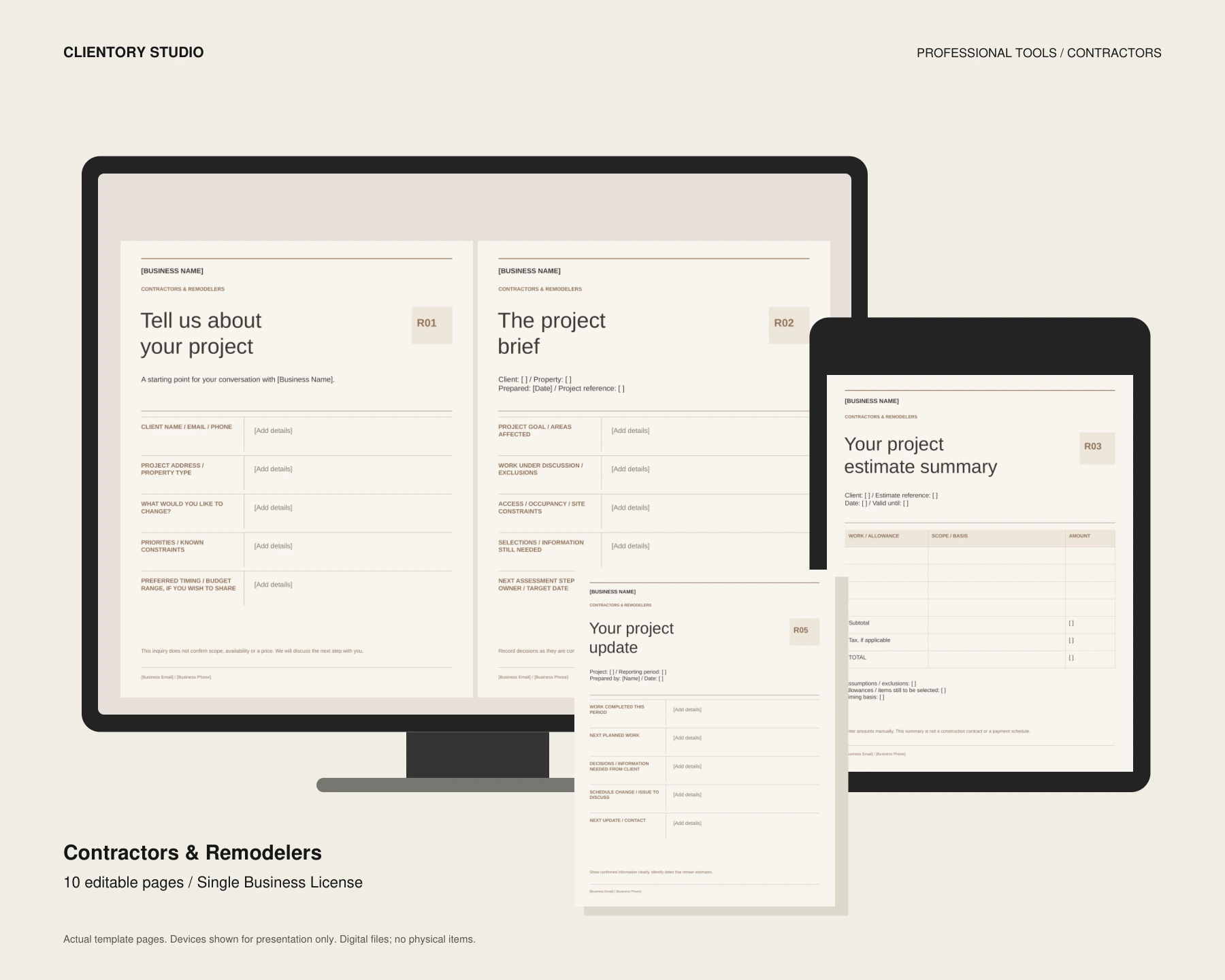
The Contractors Job Records pack includes project, change and walkthrough records that can support an organized manual evidence trail. It is not a statutory payment-claim form or an accounting system.
The Client Messages pack provides editable project communication. Use locally appropriate, professionally reviewed payment terms and the correct formal process where required.
Keep the evidence proportionate
Send the records relevant to the payment basis, using an organized reference rather than an indiscriminate collection of site photographs. More attachments do not necessarily make a claim clearer. Keep sensitive information out of unnecessary circulation and retain the underlying records securely for the appropriate period.
Check one invoice from the client’s perspective
Take the next planned invoice and ask whether a person unfamiliar with your internal codes can identify the agreed basis, the work being claimed and how the amount was calculated. Then check it against the agreement and the account.
The purpose is not to send a larger attachment bundle. It is to make the relevant evidence easy to find. A clear account will not remove every payment risk, but it gives a fair conversation a much firmer starting point.
Sources and product information checked on 20 October 2026. Worked scenarios are illustrative, not industry benchmarks.