Pre-Black Friday Special on every Complete System: US$59 US$39 until Sunday, Nov 29 (US$59 from Nov 30). See the systems →
How to Close a Remodeling Punch List Without Delays
Organise a remodeling punch list with clear descriptions, owners, access and verification. Separate completion records from payment and legal decisions.

CONTRACTORS & REMODELERS | FIELD GUIDE
The final list needs more than boxes to tick. Each item should be specific enough to assign, resolve and verify.
The major work is complete, but the project continues through messages about a door, a paint touch-up and an adjustment nobody can locate on the latest list. One person says an item is finished. Another says they have not seen it. The business is still carrying the job mentally long after the main crew has moved on.
A remodeling punch list should turn that unsettled final stage into a visible process. In the UK, readers may use snagging list; Canadian projects may use deficiency list. Terminology varies, and the legal meaning of completion remains specific to the agreement and location.
The practical need is shared: describe the remaining issue accurately, identify who will deal with it, arrange access and verify the outcome. A list that does those things is useful. A list that merely gets longer is another inbox.
Separate observations from conclusions
Begin with what can actually be observed. “Kitchen cabinet door beside refrigerator catches when closing” is easier to investigate than “kitchen not finished”. Identify the location precisely and add a permitted photograph or reference where it helps.
Do not decide every technical cause during the walkthrough. The person recording an observation may not be competent to diagnose it. Mark an item as requiring assessment when that is the appropriate next step, then assign it to someone qualified to investigate.
Distinguish remaining agreed work, a reported defect, a new customer request and a question about use or maintenance. They should not be treated as automatically identical obligations. Equally, avoid classifying a concern as an extra simply because it arises late in the project.
Keep urgent concerns out of the ordinary queue
A concern involving immediate safety, active damage or another serious issue requires an appropriate response rather than waiting for the next routine closeout visit. Establish an escalation route and make it visible to the people recording items.
This article does not provide technical defect standards or emergency advice. Use the relevant competent professional, contractual process and local requirements when assessing the issue. The administrative list supports that work; it does not determine whether the building is safe or compliant.
| A usable list item | Why it helps |
|---|---|
| Unique reference and location | The client and trade can identify the same issue without guessing. |
| Specific observation | Describes what needs investigation or completion without inventing a diagnosis. |
| Responsible owner and next step | Someone coordinates the action and any required access. |
| Verification record | Shows who checked the outcome, when, and whether anything remains open. |
Use statuses that reflect reality
An item can be recorded, awaiting assessment, awaiting access, assigned, reported complete or verified as resolved. You do not need all of these for every small project, but you do need to distinguish a trade saying it is done from the appropriate review confirming the outcome.
Choose a manageable set of statuses and define them. If everybody uses complete differently, the list will give false reassurance. A contractor might mean the operative has left the site, while the client means the issue has been checked and accepted.
Keep a dated history for meaningful changes rather than overwriting every earlier entry. If the observation changes after investigation, preserve enough context to understand why. Avoid unnecessary personal information or informal comments that would make the shared record unprofessional.
Specialist construction software provider Bluebeam’s punch list guide offers context for tracking and assigning closeout items. It is a vendor resource, not an independent statement of completion law. Choose tools according to project complexity and the process you need to maintain.
Move an item towards a verified outcome
1. Record
Identify the location and the specific observation.
Identify the location and the specific observation.
2. Assess and assign
Confirm the appropriate action, responsible person and any approvals.
Confirm the appropriate action, responsible person and any approvals.
3. Coordinate
Arrange access and communicate the planned intervention.
Arrange access and communicate the planned intervention.
4. Verify and retain
Check the outcome appropriately and keep the completion record.
Check the outcome appropriately and keep the completion record.
Group the visits without losing accountability
Several small items may be handled efficiently on one suitably planned visit. Group them by trade, access requirement or location, while keeping their individual references. Confirm that the planned operative can perform each task competently and has the required materials or instructions.
An access conversation should identify the date or window, the work areas and any practical arrangements the occupant needs to understand. Avoid an open-ended statement that somebody will drop in. The final stage of a project can feel intrusive precisely because the client expected normal use of the home to have resumed.
If a visit cannot resolve every item, update the record honestly. A partial intervention should not close the whole item if further work or verification remains. Tell the client what happened, what remains and when the next decision or contact is expected.
Make the owner responsible for coordination
The person assigned to an item need not personally perform all the work. They should make sure the next step is clear and followed through. Without that coordinating responsibility, an issue can move repeatedly between the client, main contractor and trade without progressing.
Use realistic dates. Distinguish a target from a confirmed appointment and explain when material availability or another dependency remains uncertain. A sequence of missed confident promises can be more damaging than a candid assessment of what is still being arranged.
Measure progress by status, not by a vague percentage
Imagine a fictional list of 20 items. Twelve have been verified as resolved, five have been reported complete but await review, and three remain open. That is 60% verified, 25% awaiting verification and 15% open.
Calling the project 85% closed would combine two different states. It might be useful internally if clearly defined, but it should not imply that 17 items have been verified. Item counts also say nothing about the relative significance of each issue. One serious unresolved matter can matter more than many small completed adjustments.
Use the figures to coordinate the list, not to certify overall completion or determine payment rights. The simplified example does not assign technical severity or legal effect to any item.
A clearer picture of a 20-item list
Verified as resolved
12 items, 60%
Reported complete, awaiting review
5 items, 25%
Open
3 items, 15%
Keep closeout separate from legal shortcuts
A completed checklist does not automatically settle warranties, statutory rights, final payment, retention or the contractual meaning of practical completion. Nor does an unresolved item automatically justify withholding any amount the client chooses. Those decisions depend on the relevant framework.
The UK’s NHBC provides training on snagging and handovers, illustrating that closeout deserves a structured professional process. The course page is not a substitute for a technical standard or project-specific advice, and its context should not be applied as a warranty scheme for every remodel.
For a material disagreement, preserve the records and seek the appropriate local advice or dispute route. Avoid using a walkthrough signature as a broad waiver unless its meaning and validity have been properly established. The useful role of a shared list is clarity, not the removal of legitimate rights.
Turn a broad concern into one usable record
Example only: “Item P07. Location: utility room, door nearest the rear entrance. Observation: the door catches when closing. Next step: responsible trade to assess the cause and suitable correction. Coordination owner: project lead. Access: confirm a suitable appointment with the occupant. Status: awaiting assessment. Verification: remain open until the appropriate check is recorded.”
This records a concern without prescribing a repair or declaring a defect before assessment. If the investigation identifies several separate issues, create linked items rather than expanding one description until nobody knows which part is complete.
A practical resource for this step
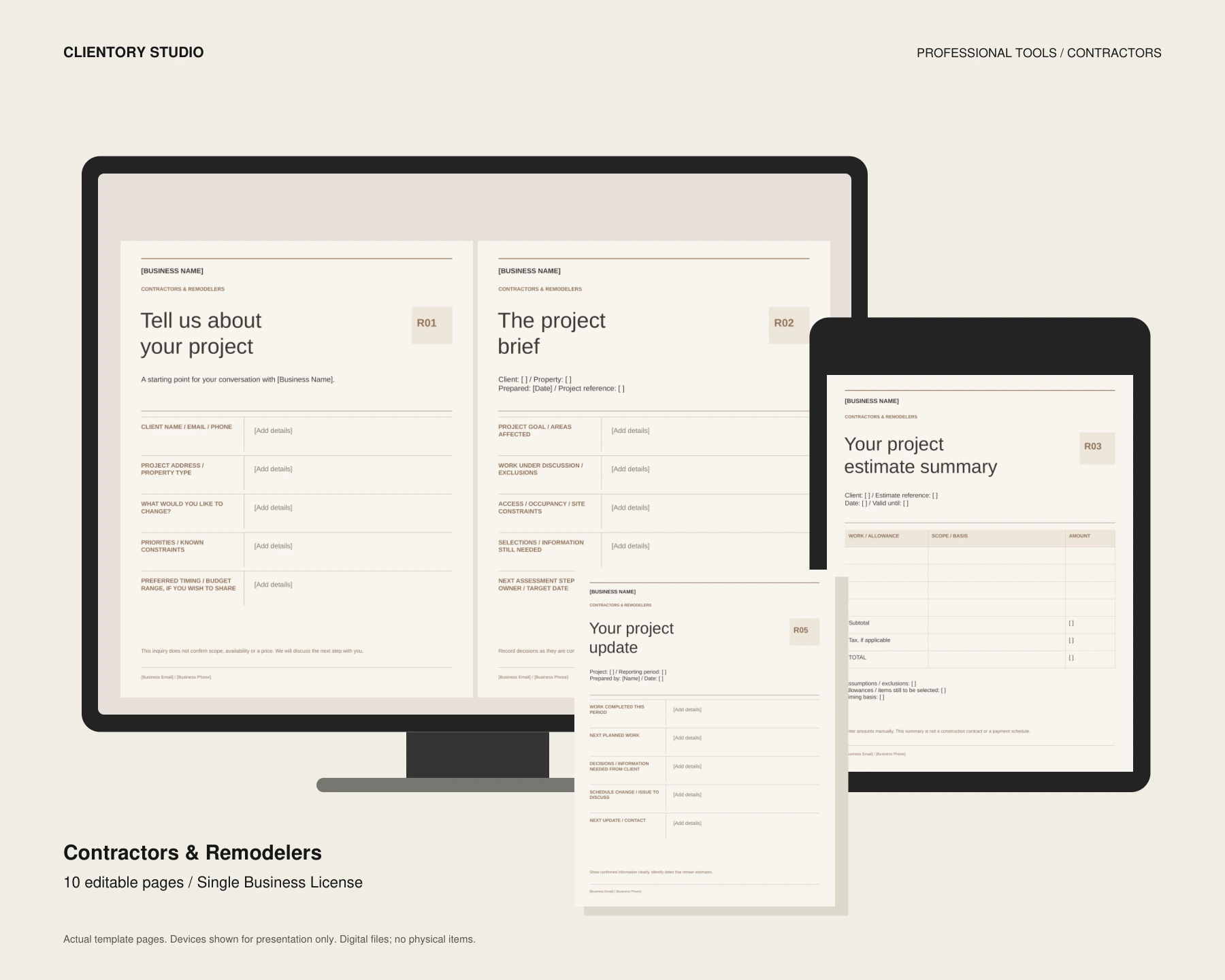
The Contractors Job Records pack includes walkthrough, project and change records that can support a manual closeout process. Adapt the fields and statuses to the job.
The Client Messages pack provides editable walkthrough and project communication. Neither resource performs an inspection, certifies completion or decides payment entitlement.
Close the information loop
At the end of the process, provide an appropriate summary of resolved items, remaining agreed actions and relevant handover information. Retain the current record in a place the business can find later. Avoid leaving the final position scattered across several unconnected message threads.
For the next walkthrough, improve just one item before leaving the site: make sure its location, owner and next step are unambiguous. That is the standard every other item should meet. A clear closeout process gives the client a more understandable finish and gives your team a practical route to stop carrying an undefined list.
Sources and product information checked on 20 October 2026. Worked scenarios are illustrative, not industry benchmarks.