Business templates made for real service businesses.
Aeration or Dethatching?
Compare lawn aeration and dethatching by the problem present, turf type, timing, and recovery needs before recommending a service to your customer.

Landscaping & Lawn Care · United States
In this guide
A customer asks for dethatching because a neighbor booked it. Your crew has an aerator available next week. The lawn feels spongy in one area, hard in another, and thin under a tree. None of those facts, by itself, establishes which service the property needs.
For a lawn-care business, the profitable decision is not automatically the larger package. It is a recommendation that fits the observed problem and can be explained afterward. This comparison gives you a practical assessment and communication process. It does not treat every thin lawn as a candidate for cultivation or promise that one visit will fix every cause of poor growth.
Know what you are comparing
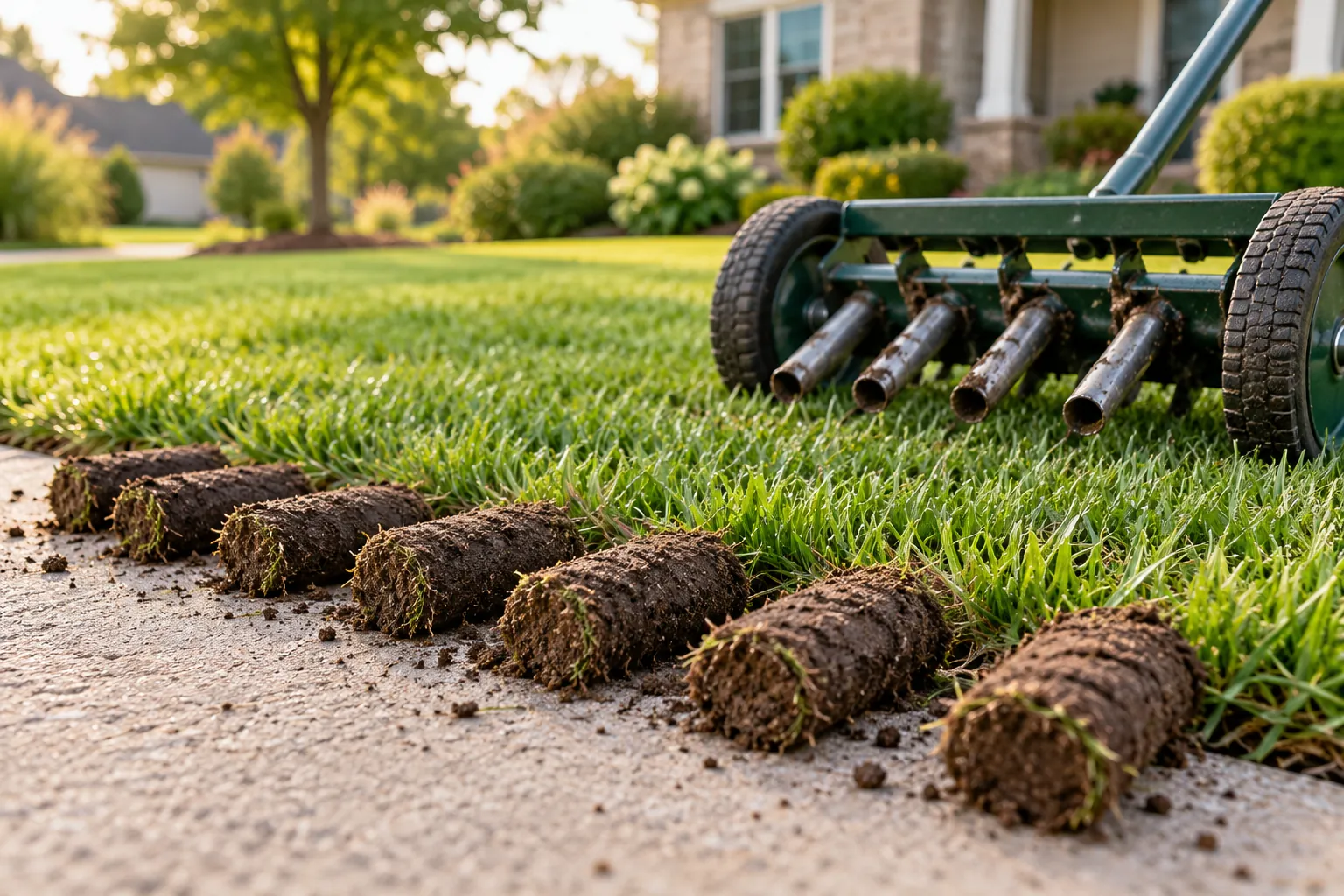
Core aeration removes plugs of soil and organic material. Dethatching uses an appropriate method to remove part of the accumulated organic layer between green growth and soil. The terms are often mixed together in customer inquiries, so explain the difference before discussing a package.
Utah State University Extension distinguishes core aerification, solid-tine methods, and dethatching. It also explains why active growth and grass type matter to timing. A calendar suitable for one region and turf type should not become a nationwide booking rule.
Do not confuse a layer of loose clippings with an established thatch problem. University of Minnesota Extension describes thatch as an interwoven layer and discusses its management. Your assessment should identify the actual condition instead of using “thatch” as a catch-all label for brown material.
Inspect representative areas
Walk the lawn with the customer and divide it into meaningful zones. A heavily used path, shaded side yard, and open front lawn may have different problems. Record where the customer notices poor performance and what has changed recently: traffic, construction, irrigation, mowing, or previous treatments.
Use appropriate inspection methods to assess the soil and thatch in representative locations. Record the evidence and its location, not just a single overall impression. If you cannot confidently identify the turf or diagnose the condition, use a qualified local resource rather than selling a treatment as a diagnostic experiment.
Ask about recent pesticide or fertilizer applications and planned seeding. Some products and activities affect the timing of other work. Follow the relevant label and local guidance; customer approval does not override those instructions. Keep this separate from whether your crew is legally qualified to apply a product.
Compare the options against the problem
| Decision factor | Core aeration | Dethatching |
|---|---|---|
| Main assessment | Soil compaction and conditions affecting the root zone | Accumulated thatch and its effect on the turf |
| Evidence needed | Site observations and appropriate soil assessment | Inspection of the actual organic layer |
| Timing | Suitable growth period and ground conditions | Suitable growth period and recovery conditions |
| Service implications | Access, equipment, cores, follow-up expectations | Equipment, removed material, cleanup, recovery |
| Not a substitute for | Correcting every drainage, shade, or disease problem | Diagnosing every reason for a thin lawn |
The table is a conversation aid, not a prescription. A property can have more than one issue, and either treatment may be inappropriate at the time of the inquiry. Where a combined program is justified, explain the reason and sequence rather than bundling services because the equipment will already be nearby.
For example, a compacted area caused by repeated foot traffic may also need a change in use. Treating the ground without addressing the traffic pattern can leave the customer expecting a permanent result from a temporary intervention. Make that dependency part of the recommendation.
Use a simple recommendation path
- Identify turf and affected zones
- Inspect soil and thatch conditions
- Check local timing and treatment history
- Choose treatment, further assessment, or deferral
- Agree on recovery and follow-up
If the main cause is still uncertain, the next paid service may be an assessment rather than cultivation. If timing is unsuitable, offer a future review window based on local guidance. If the site has no established need, explain that observation instead of finding a reason to sell an unnecessary pass.
Document why you selected the option. “Customer requested dethatching” is a record of the request, not evidence supporting the recommendation. A better entry describes the zone, observed condition, guidance used, and any limits or unresolved questions.
Make the scope visible before pricing
Define the treatment area, method, access requirements, and cleanup. Tell the customer what the lawn may look like immediately afterward and what follow-up is included. Avoid promising a precise recovery date without considering the turf, weather, and maintenance conditions.
Clarify whether seeding, fertilizer, debris removal, or irrigation adjustments are part of the service. These are separate decisions, not automatic meanings of “aeration package.” If you recommend additional work, explain its purpose and whether your business performs it or refers it to another provider.
Our landscaping scope-of-work guide helps turn that recommendation into a clear customer promise. Keep the technical decision in this article distinct from the pricing process: the first question is what work is appropriate, then what it takes to deliver it.
Include the less visible labor
Machine time is only part of a cultivation visit. Include the site assessment, loading, access setup, identifying protected features, cleanup where applicable, and the handoff. Do not assume that two lawns of equal area create the same workload.
Consider an illustrative visit with 50 minutes of machine work, 20 minutes of setup and loading, and 15 minutes of site review and customer communication. The total is 85 minutes before travel. If cleanup adds another 25 minutes, the planned time becomes 110 minutes. These are example inputs, not production benchmarks.
Use your own measured durations to refine the estimate. If a narrow gate requires different equipment or a distant unloading point adds handling time, record the reason. Otherwise, the next quote may repeat the same optimistic assumption even after the crew reports that the job ran long.
Agree on the customer’s part in recovery
Explain the follow-up responsibilities that actually apply to the selected service. If the plan depends on watering, traffic restrictions, or a maintenance change, establish whether the client can realistically provide them. Do not sell a result that assumes care the customer has already said is impossible.
Provide instructions tied to the chosen treatment and local guidance. A short written handoff is easier to follow than a long conversation beside the truck. Identify who the customer should contact if conditions change or the lawn’s response differs from the agreed expectations.
Where irrigation problems are observed, document and route them separately. Our guide to reporting irrigation issues explains how to move an observation to a responsible next action without implying that the mowing crew has diagnosed or repaired the system.
Review outcomes without inventing a success rate
Choose a follow-up point appropriate to the service and record comparable observations. Photographs should use consistent locations and conditions where practical. Note weather and maintenance changes that affect interpretation. A greener photo alone cannot prove which part of a program caused the difference.
Track whether the original recommendation was supported, whether the scope was delivered, and whether the client completed agreed follow-up. If the outcome is disappointing, revisit the diagnosis rather than automatically repeating the treatment. Distinguish a service-delivery issue from a condition requiring a different specialist.
Keep a few well-documented cases for internal learning, with customer permission where needed. Do not turn a fictional calculation or selected before-and-after image into a claim that every customer will receive the same result.
What if the customer insists on the wrong service?
Explain the observed condition and the decision still needed. Offer the assessment or review option your business can support instead of agreeing to an unsuitable treatment with a vague disclaimer. A customer may be using the wrong term while describing a real concern, so first clarify the result they want. If they still request work you cannot responsibly recommend, decline that scope and document the discussion. Keep the tone practical: the aim is to avoid paying for an intervention that does not address the identified problem. Where another specialist is needed, tell the client what information to provide, such as turf type, affected zones, treatment history, and representative photographs. A useful referral preserves the relationship and leaves a clear starting point for the next professional.
Put the recommendation in the property plan
Before the next inquiry, prepare three possible answers: treatment now, assessment first, or review later. Then make the choice from the property rather than the sales calendar. The customer should leave understanding why the recommended service fits the lawn and what must happen for it to have a reasonable chance of success.
Updated in 2026. Prepared by Clientory Studio with AI-assisted research and editorial review. Numerical scenarios are illustrations unless a source is named. Generated editorial imagery is illustrative, not a photograph of a Clientory customer project.