Business templates made for real service businesses.
Stop Mower Seed Spread
Create a between-property mower-cleaning routine that addresses seed-bearing debris, transport, disposal, route planning, and crew accountability.

Landscaping & Lawn Care · United States
In this guide
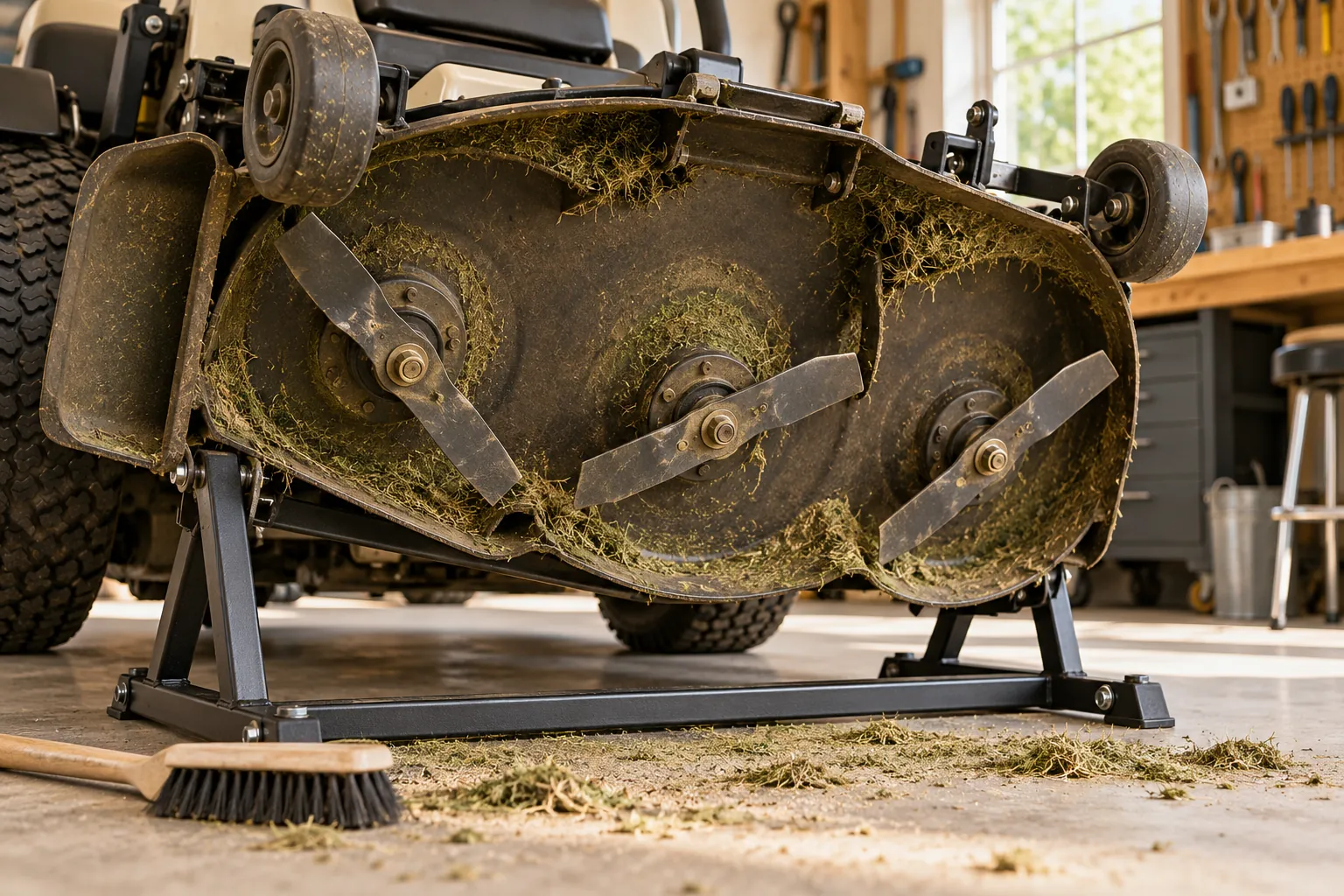
A mower leaves one property with clippings packed around its wheels and deck. It reaches the next lawn, where some of that material falls off during unloading. The route is efficient on the calendar, but the equipment has carried part of the first site into the second.
For a small lawn-care company, preventing avoidable seed movement is a practical service-quality issue. It requires more than keeping the truck visually tidy. The team needs to know which sites create a concern, where cleaning can happen, and how to handle collected material without simply moving it somewhere else.
Understand the pathway you can control
Weed seeds and other plant material can travel with equipment and retained debris. University of California’s WeedCUT guidance identifies equipment cleaning between sites as a way to limit spread and notes that mowing timing can affect seed dispersal. Its wildland context is broader than a residential route, so use the principle with guidance appropriate to the actual species and property.
Do not claim that cleaning equipment will make a customer’s lawn weed-free. Seeds can arrive through other pathways, and the lawn may already contain a seed bank. Your commitment is to a defined handling practice under your control, not a guarantee about every future plant.
Keep weed-seed prevention distinct from disease management. Some turf diseases require their own procedures, and not every discolored lawn has an infectious cause. University of Florida IFAS recommends confirming suspected disease problems with appropriate local expertise. Do not apply a generic sanitation recipe to every unknown patch.
Identify the properties that need attention
Ask crews to report visible seed-bearing weeds and changes in known problem areas. Record the location and, where appropriate, photographs for identification. A crew member should be able to flag uncertainty without needing to identify every species correctly in the field.
Use local extension or another qualified resource when identification affects the management decision. Species, growth stage, local restrictions, and disposal requirements can change what is appropriate. If a regulated invasive plant may be involved, confirm the applicable requirements before transporting material off site.
Add a property flag that describes the action, not just the concern. “Seed-bearing weeds observed along rear fence; supervisor to confirm mowing and debris plan” gives the next crew a task. “Weedy lawn” is too vague to guide a route or cleaning decision.
Plan cleaning before you need it
Decide where equipment can be cleaned without spreading material into an unaffected area, public path, drain, or another customer’s property. Coordinate that location with the site contact. Do not assume the edge of the street is an acceptable disposal point.
Provide the tools and collection arrangement required by the approved method. Follow the mower manufacturer’s shutdown, isolation, and cleaning instructions. Never reach into or under operating equipment or improvise a lifting arrangement to keep the route moving. The cleaning task belongs in training and scheduling, not just in a note at the bottom of the job sheet.
Consider transport equipment too. Ramps, trailers, mats, boots, and hand tools can retain debris. Your inspection should follow the actual movement of material through the operation. A spotless mower deck does not help if a trailer carries a pile of contaminated clippings to the next stop.
Use a simple departure sequence
- Flag the site condition
- Confirm the approved work and cleanup location
- Safely remove retained plant material
- Contain and handle debris appropriately
- Inspect transport points before departure
Assign the final check to a named role. In a two-person crew, one person may perform the cleaning and the lead may confirm that the departure condition has been met. In a solo operation, use the same short checklist without creating a fictional second-person sign-off.
Record exceptions rather than filling a page with repeated “done” entries. If the normal cleaning location is unavailable, the next action should be visible before the equipment moves to another property. Escalate for an appropriate alternative instead of skipping the step silently.
Keep the debris decision connected to the species
| Material or situation | Decision needed | Record to retain |
|---|---|---|
| Routine retained clippings | Approved collection and handling method | Completion or exception |
| Seed-bearing weeds | Species and spread considerations | Site location and guidance used |
| Suspected regulated invasive plant | Local handling and transport requirements | Responsible contact and instructions |
| Unknown diseased material | Appropriate diagnosis and sanitation advice | Observation and referral |
| No suitable cleaning area | Alternative arrangement before onward work | Approval and next action |
Avoid treating bagging as a complete solution. The material still needs an appropriate destination and handling method. Composting, leaving material on site, or transporting it elsewhere may have different implications depending on the species and local rules. Verify rather than assuming that every green-waste facility accepts every material.
Keep any chemical treatment separate from this equipment-cleaning routine. A customer request to spray the weeds creates additional qualification, label, and jurisdiction questions. It should not be approved automatically because the crew has already identified a seed-spread concern.
Adjust the route without creating a false shortcut
Scheduling a known problem property later in the route may help coordinate work, but it does not replace equipment cleaning. The machine can still carry material into the trailer, yard, or next day’s first property. Treat route order as one operating choice within a complete process.
Build realistic time into the schedule. In a fictional five-stop route, four between-site checks taking eight minutes each require 32 minutes. If the daily plan has no room for those checks, the written policy is competing with the production target. The example is a scheduling illustration, not a standard cleaning duration.
Measure your own task time by equipment and site condition. A light inspection after a routine visit is different from removing substantial retained material. Use the results to improve scheduling rather than setting an arbitrary speed target that discourages thorough work.
Tell the customer what the practice does
Use measured language: “We inspect and clean retained plant material from equipment using our between-property procedure. Where seed-bearing or invasive plants are identified, we review the mowing and debris plan before continuing.” That describes an action you can audit without claiming total control over weed growth.
If the property needs additional management, explain the observation and the next step. “We found seed-bearing plants in the rear border and need identification before deciding how to handle that section” is more useful than naming a species from an uncertain photograph.
Our landscaping scope-of-work guide helps separate routine mowing from a specialist vegetation-management request. A customer can approve an assessment without accidentally authorizing an unspecified treatment program.
Review the process at the end of the week
Look for repeated exceptions: no cleaning area, missing collection tools, unclear species identification, or routes that leave no time for the procedure. Fix the most common constraint first. A reminder to “be cleaner” will not solve a missing tool or an impossible schedule.
Ask the crew where debris accumulates on each machine and transport setup. Use the manufacturer’s instructions to refine the inspection points. If a method creates another hazard or damages equipment, stop using it and obtain an appropriate alternative.
Do not use a weed complaint as proof that your crew introduced the plant. Review the history and evidence fairly. The record should show what was observed and what handling practice was used, not manufacture certainty about a biological source that has not been established.
Keep site flags in the visit plan
Use the before-and-after visit system to close the loop with the client when a concern affects the visit. Keep the message brief enough to be read and precise enough to support the next decision.
How do you keep the process consistent with seasonal staff?
Include equipment-cleaning checkpoints in the route briefing and demonstrate the approved maintenance procedure before assigning the task. Ask the worker to explain where removed debris goes and when the next property can begin. Keep required tools available at the planned location. A written instruction cannot compensate for a route that provides no time or suitable place to carry it out.
Start with one machine and one route
Map where debris accumulates, confirm the safe cleaning procedure, and identify an appropriate handling location at the relevant properties. Add the time to the route, then test whether the team can complete the process as written.
After the pilot, retain the steps that workers can consistently verify and resolve the practical obstacles. Preventing avoidable seed movement becomes more dependable when it is part of departure, rather than an optional task remembered only after a customer reports weeds.
Updated in 2026. Prepared by Clientory Studio with AI-assisted research and editorial review. Numerical scenarios are illustrations unless a source is named. Generated editorial imagery is illustrative, not a photograph of a Clientory customer project.