Pre-Black Friday Special on every Complete System: US$59 US$39 until Sunday, Nov 29 (US$59 from Nov 30). See the systems →
Detailing Matte Paint
Adapt your detailing intake, products, correction limits, and handoff for matte paint without promising gloss-style polishing or unverified protection.

Auto Detailing · United States
In this guide
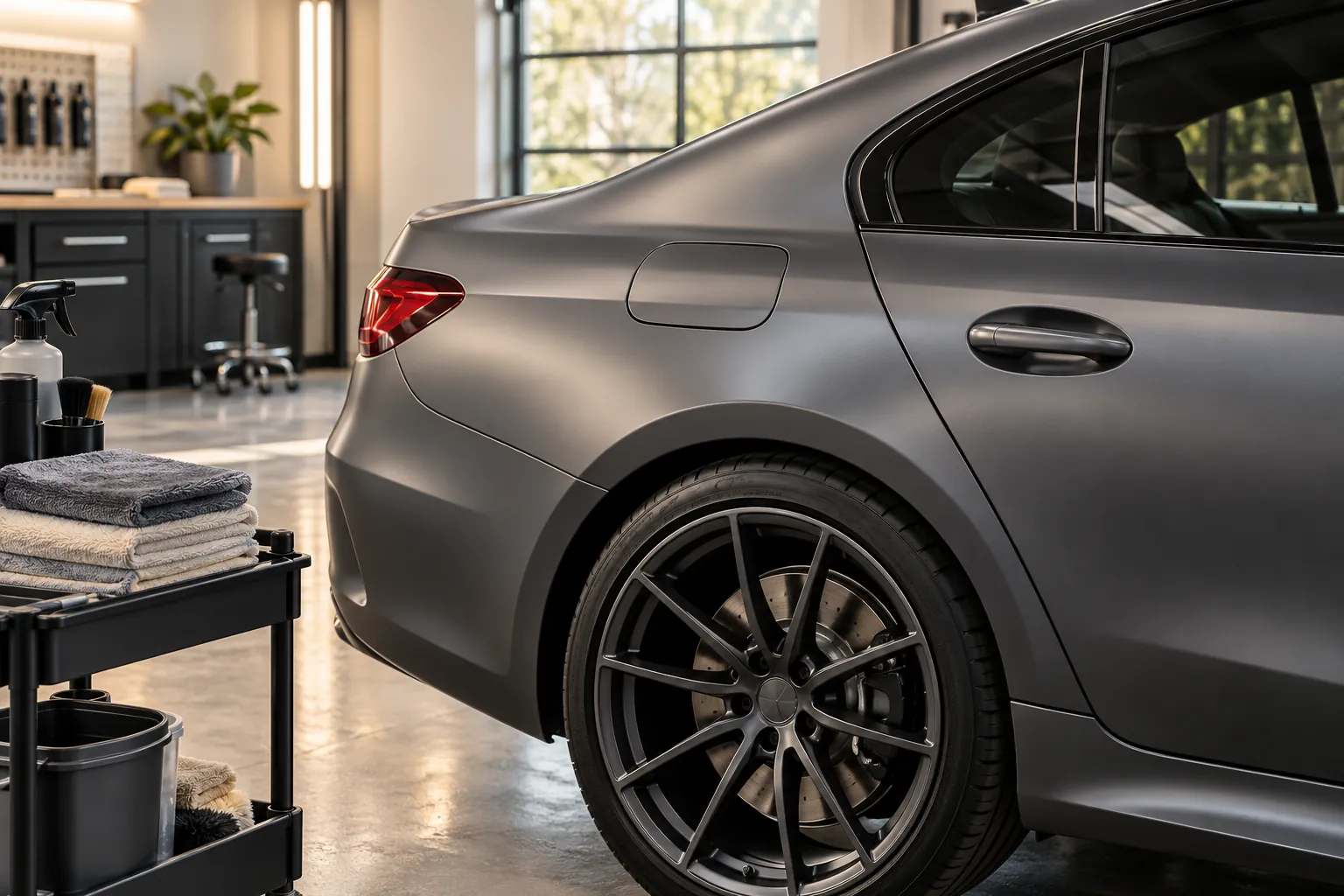
A matte vehicle arrives for the business’s premium exterior package. The package normally includes decontamination, polishing, and protection. The technician is experienced with glossy clear coat, but the customer’s finish is designed to look different. Applying the familiar package unchanged can defeat the result the owner wants to preserve.
Matte work is not simply a normal detail performed more carefully. It requires different decisions at intake, product selection, defect discussion, and handoff. The business needs to make those differences visible before the customer purchases a service built around increasing gloss.
Identify what the surface actually is
Ask whether the finish is original paint, refinished paint, a vinyl wrap, or paint-protection film. A matte appearance does not establish the material. Request the vehicle’s care guidance and any installer documentation for aftermarket surfaces or coatings.
Record mixed surfaces separately. A vehicle may combine matte film, glossy painted trim, textured plastics, and previously repaired panels. A product suitable for one area may not be suitable for all of them. Mark the differences on the job brief so a second technician does not assume the entire exterior follows one method.
If the owner does not know the surface history, identify the uncertainty and choose a suitable assessment path. Do not make a confident material claim from appearance alone. The cost of a short clarification is small compared with promising correction on a finish whose care restrictions are unknown.
Change the definition of a successful detail
For glossy paint, customers often associate improvement with stronger reflections and fewer visible defects. For matte paint, preserving the intended sheen and an even appearance is central. A brighter patch may be a problem rather than proof of successful polishing.
Dr. Beasley’s matte-paint guide explains how matte appearance depends on the finish’s surface characteristics and why ordinary polishing can alter them. It also distinguishes products designed for matte use from conventional gloss-enhancing choices. Verify recommendations against the vehicle or surface manufacturer’s instructions.
Avoid repeating marketing claims that every matte product is appropriate for every matte surface. Paint, wrap, and film manufacturers may have different requirements. A supplier’s label is useful evidence, but it does not remove the need to match the product to the specific vehicle and existing treatment.
| Familiar gloss-service assumption | Matte-service question | Scope implication |
|---|---|---|
| Polishing improves appearance | Is correction permitted for this finish? | Exclude unapproved polishing |
| More shine is desirable | What sheen should be preserved? | Agree on the intended appearance |
| One protection product fits all | Is it approved for this surface? | Verify compatibility before quoting |
| A scratch can be chased locally | Could localized work change the finish? | Refer when appropriate |
Inspect in consistent light before discussing defects
Walk around the vehicle with the owner when possible. Photograph existing scratches, stains, uneven sheen, and prior repairs in useful lighting. Include wider views that locate the issue as well as close views. A close-up without context may be difficult to interpret later.
Describe observations without claiming to know the cause. “This area reflects differently from the adjacent panel” is a useful statement. “Someone used the wrong wax” may be an unsupported conclusion. Ask about previous care, then record the answer as customer-reported history.
Agree on which concerns the proposed service addresses. Routine cleaning may improve surface contamination while leaving scratches or finish variation unchanged. Our guide to realistic paint-correction expectations provides a broader framework for separating a customer’s desired appearance from a technically supportable promise.
Audit the package before the technician starts
Review every step and product in the standard package. Look for gloss enhancers, polishing stages, abrasive methods, and protection products that have not been verified for the identified finish. Do not leave the technician to discover these conflicts after the vehicle is washed and the appointment is half over.
Create a matte-specific work order rather than simply writing “be careful” beside a normal package. List approved products and the applicable instructions. Identify excluded steps clearly, especially where another employee might otherwise perform them automatically during quality control.
Keep tools clean and appropriate for the planned process. Prevent accidental transfer of polishing residue or incompatible products from another job. Organize the workstation so the selected products are easy to identify and the excluded ones are not sitting beside the vehicle inviting a routine habit.
Use a small verification step within the approved method
Where the applicable instructions support it, verify the selected process in an appropriate area before proceeding widely. The purpose is to confirm the expected behavior of a compatible method, not to experiment with an otherwise prohibited technique on a less visible panel.
Review the result under comparable conditions and record any unexpected change. If the appearance differs from expectations, stop and consult the relevant manufacturer or qualified specialist. More passes or a stronger product may amplify the problem rather than answer the compatibility question.
Do not let customer approval substitute for technical suitability. An owner may consent to a test without understanding a finish’s limitations. Your role is to explain what the service can support and decline a method that falls outside the verified process.
Discuss scratches without selling a gloss-style correction
A customer may ask, “Can you just polish that one spot?” Explain that a localized process can affect the appearance differently on matte surfaces. Avoid guaranteeing that a scratch can be removed while the surrounding sheen remains unchanged.
If the concern requires refinishing or another specialist assessment, separate that referral from the maintenance detail. The customer can still choose to have the vehicle cleaned while understanding that the visible defect remains. Put that distinction in the estimate rather than relying on a conversation remembered differently at pickup.
An example of clear wording is: “This service cleans and maintains the identified matte finish under the applicable care instructions. It does not include abrasive correction or promise removal of the marked scratch. We recommend a specialist assessment before any repair attempt.” Adapt it to the actual surface and guidance.
Price preparation and product verification as real work
Matte detailing may require additional inspection, product verification, setup, and customer explanation. Measure these tasks in your own operation. Do not add an arbitrary premium solely because the vehicle looks unusual, and do not assume that removing a polishing stage automatically makes the job quicker.
Consider a fictional appointment with 25 minutes of extra inspection and compatibility review plus 15 minutes for a more detailed handoff. That is 40 minutes of work. At an illustrative internal labor cost of $30 per hour, it represents $20 before product differences and overhead. These are sample inputs, not a market rate.
Use your detailing package guide to describe the revised service in terms of actual deliverables. A customer should understand what changes and why, rather than seeing a mysterious surcharge attached to the word “matte.”
Make aftercare specific to the finish
Give the owner the applicable care reference and a short explanation of the products or treatment used. Identify any follow-up conditions that come from those instructions. Avoid a universal maintenance interval or broad protection guarantee unsupported by the selected system and use conditions.
If the owner normally visits an automatic wash or uses a generic quick-detail spray, explain that future care should follow the surface manufacturer’s guidance. Keep the conversation practical: what document to consult, what product identity to verify, and whom to contact when a new mark appears.
Document the final condition using comparable photographs. The goal is a clear record of the service, not an image edited to make the finish look glossier. Marketing photographs should represent the intended appearance and should not imply that polishing created a result you deliberately avoided.
What should a replacement technician see first?
The work order should identify the surface, applicable care reference, approved products, excluded steps, and existing concerns before the technician selects a tool. Use the same terminology in the estimate and field brief. If the customer called the service a polish but the approved scope is maintenance cleaning, resolve that wording immediately. A clear handoff is especially valuable when a quality-control employee normally performs a final gloss-enhancing step on every vehicle. Make the intentional exception visible rather than relying on someone remembering a conversation from the morning.
Build the next booking around the correct scope
Before offering your next matte appointment, audit one standard exterior package line by line. Remove unsupported steps, name the verified process, and prepare the defect explanation in advance. That gives both the customer and the technician a service built for the finish that is actually on the vehicle.
Updated in 2026. Prepared by Clientory Studio with AI-assisted research and editorial review. Numerical scenarios are illustrations unless a source is named. Generated editorial imagery is illustrative, not a photograph of a Clientory customer project.