Pre-Black Friday Special on every Complete System: US$59 US$39 until Sunday, Nov 29 (US$59 from Nov 30). See the systems →
Child Car Seats: Set Your Auto Detailing Scope
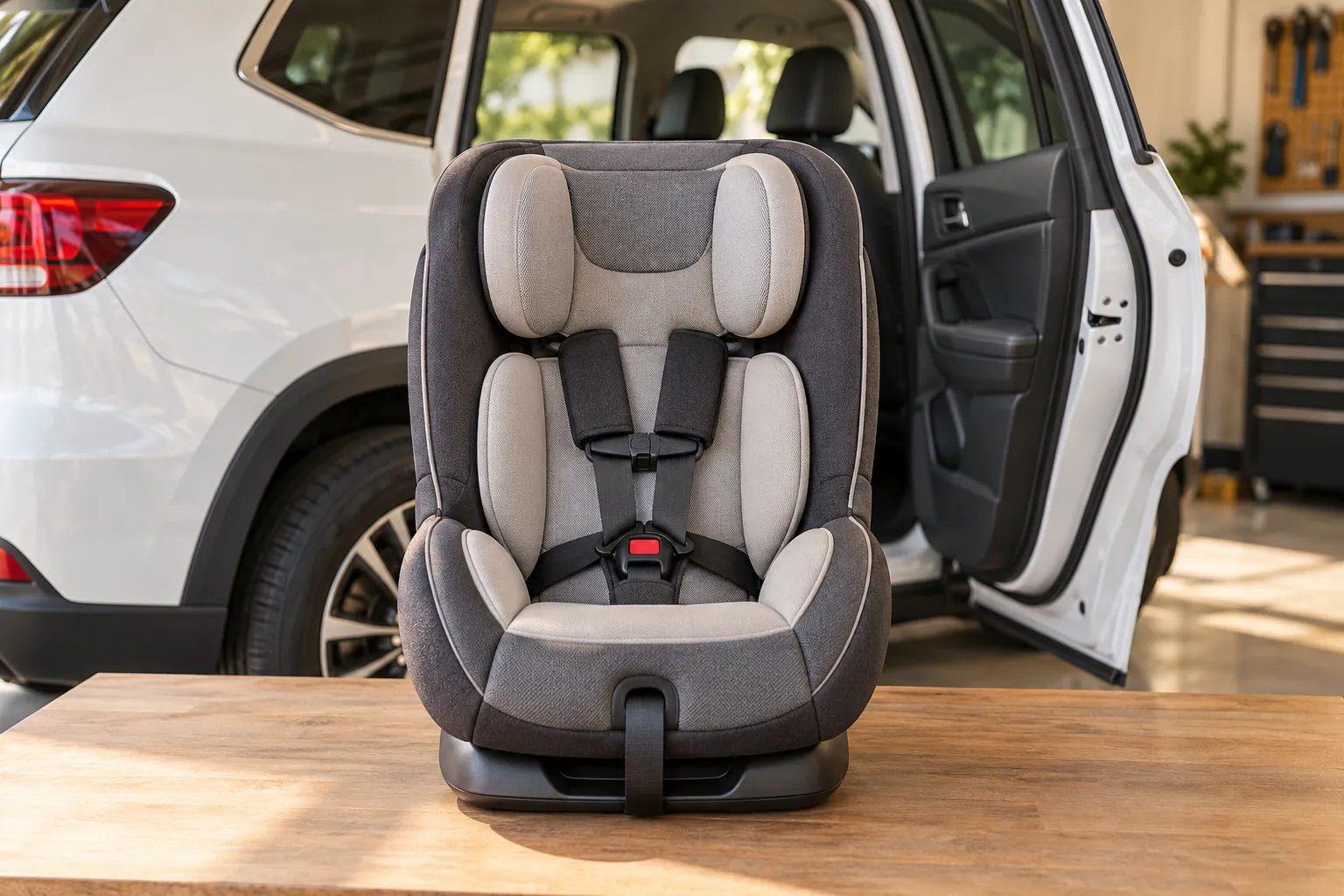
Set a clear policy for child car seats during detailing, including removal, manufacturer-specific cleaning limits, storage, and the customer handoff.

Auto Detailing · United States
In this guide
A family vehicle arrives with crumbs around a child seat and a stain on its cover. The customer assumes the seat is included in the interior package. The technician assumes the customer will remove it. Neither expectation is written down, and the pickup deadline is already approaching.
Child restraints need a specific service boundary because cleaning, removal, reassembly, and installation are different tasks. A detailer’s skill with automotive upholstery does not automatically establish competence with each restraint model. A clear policy protects the workflow and gives parents useful information before they hand over the keys.
Choose the service boundary before accepting the booking
One workable policy is to require the customer to remove child restraints before the appointment so the team can clean the vehicle’s accessible interior. Another is to leave installed restraints untouched and explicitly exclude the areas beneath them. The right choice depends on the business’s capabilities and service design.
If you offer restraint cleaning as a separate service, define the exact tasks, training, manufacturer documentation, and handling process required. Do not add it casually to a standard extraction package. Confirm that the service is appropriate for the specific model and that your business arrangements support the work.
Whatever policy you choose, communicate it at inquiry, confirmation, and arrival. Repeating one concise instruction at those points is useful consistency. Burying it in a long terms document that the technician never sees is not an operational plan.
Identify the model before discussing cleaning
The relevant instructions belong to the exact seat and its components. Ask the customer for the model information and user guide if a separately defined cleaning service is being considered. Do not assume that two seats from the same brand share the same fabric or cleaning method.
Britax’s cleaning guidance explicitly directs owners to the seat’s user guide and fabric care labels. It distinguishes covers that permit machine washing or drying from those requiring different care. That variation is why a generic “we steam every seat” promise is inappropriate.
Missing identification, unreadable labels, or uncertain components are reasons to stop and obtain manufacturer guidance. Do not improvise a process because a stain looks similar to one you removed from the vehicle’s upholstery. Similar fabric appearance does not establish equivalent performance requirements.
Keep removal separate from installation
Tell the customer who is responsible for removing and reinstalling the restraint. Do not imply that returning a cleaned item to the vehicle means it has been correctly installed or checked for use. A detailing completion note should describe the work performed, not certify child-passenger safety.
If a parent needs installation assistance, direct them to an appropriate child-passenger-safety resource. The NHTSA car-seat resource provides guidance and a way to find inspection assistance. A detailer should not present an informal visual glance as a substitute for qualified help.
Avoid disconnecting an installed seat merely to improve a before-and-after photograph. If the policy requires customer removal and the seat is still installed, resolve that condition before proceeding with the affected area. The technician should not be pressured to make an exception because the appointment is running late.
- Confirm the child-seat policy
- Check the arrival condition
- Apply the agreed service boundary
- Keep components and belongings controlled
- Document the customer handoff
Explain what happens when the seat remains installed
If your service leaves restraints in place, specify which surrounding areas can be cleaned without disturbing them. Do not spray, soak, or apply products onto the restraint as an incidental part of cleaning adjacent upholstery. Use a process that respects both the vehicle and restraint instructions.
Document inaccessible areas neutrally. “Area beneath the installed child restraint excluded under the agreed scope” is more useful than “customer would not cooperate.” The record should explain the result and make a future appointment easier to plan.
Before starting, offer the customer the options your policy actually supports. That may mean proceeding with the limited scope or rescheduling after removal. Avoid promising the full interior result while retaining an obstacle that makes part of the work impossible.
Do not apply one upholstery method to every component
If a properly supported separate service is offered, follow the exact manufacturer’s instructions for each component. Covers, shells, harnesses, buckles, and padding may have different restrictions. Keep their identities and permitted care methods clear throughout the process.
Do not assume that a method allowed for a removable cover is allowed for the harness or buckle. Avoid unsupported soaking, extraction, steam, strong chemicals, or replacement parts. When the manual does not answer the proposed action, contact the manufacturer rather than filling the gap with a familiar detailing technique.
This article intentionally does not provide a universal cleaning recipe or reassembly procedure. The operational value is knowing when model-specific instructions are required and keeping the service inside them. A generic procedure would erase the differences that matter most.
| Situation | What to verify | Practical response |
|---|---|---|
| Customer will remove the seat | Timing and storage plan | Confirm before arrival |
| Seat remains installed | Excluded areas | Record the limited scope |
| Separate cleaning is requested | Exact model and supported method | Quote only permitted work |
| Instructions or identity are missing | Manufacturer guidance | Defer the affected service |
Control storage and loose components
If the customer removes the restraint, agree on where it will remain during the appointment. Keep it protected from cleaning products, wet work, and accidental handling. Do not place it where it obstructs an exit or creates a trip hazard in the work area.
Use a clear method to keep customer belongings associated with the correct vehicle. For any separately authorized component handling, prevent parts from different seats from being mixed. A small lost insert or unclear component identity can turn a simple handoff into a difficult problem.
Photographs can help document the condition and items received, but they do not replace the manufacturer’s assembly instructions. Do not rely on a quick snapshot as the sole basis for reassembly or installation. Keep the service boundary intact even when a picture makes the task appear straightforward.
Build the timing into the appointment
Confirm whether the customer needs the restraint for the trip home or another journey during the service. If a separately supported cleaning process requires drying time, that dependency must be discussed before booking. Do not promise availability based only on the vehicle’s expected completion time.
The interior-drying and pickup planning guide helps organize the broader schedule. Keep restraint-specific readiness separate from the vehicle interior’s readiness. One being complete does not prove the other is ready for its intended use.
If the customer’s timing cannot accommodate the supported process, adjust or decline that part of the service. Compressing a required step to preserve a pickup promise is not a workable solution. A clear advance explanation is less disruptive than discovering the conflict when the family arrives.
Use plain language in the confirmation
For a removal-required policy, a message could read: “Please remove child car seats and boosters before your appointment. Our interior detail covers the vehicle’s accessible surfaces and does not include restraint cleaning, reassembly, or installation checks. If you cannot remove them beforehand, contact us so we can confirm the available scope.”
For an installed-seat exclusion, explain that the team will leave the restraint untouched and cannot clean beneath it. Avoid language that sounds like a legal waiver while failing to describe the actual service. The customer needs to know what to do and what result to expect.
Use the customer handover guide to repeat the relevant scope at pickup. Confirm the items returned and work completed. Do not add a safety assurance simply to make the handoff feel more complete.
What should the invoice describe?
Name the actual service performed and any agreed excluded area, without adding an installation or safety assurance.
Train the exception response
Give technicians a short instruction for an unexpected seat: pause the affected area, contact the designated person, and offer only the approved options. The employee should not need to invent a policy while standing beside the customer’s vehicle.
Review a realistic scenario during training. For example, a customer asks the technician to “just unclip it for a minute.” The team should know how to explain the boundary respectfully and continue with an agreed alternative. A consistent response is easier for customers to understand than different rules from different staff.
Before the next family-vehicle booking, add one clear child-seat question to intake and one matching instruction to confirmation. That small change resolves a significant source of uncertainty before the vehicle enters the work area.
Updated in 2026. Prepared by Clientory Studio with AI-assisted research and editorial review. Numerical scenarios are illustrations unless a source is named. Generated editorial imagery is illustrative, not a photograph of a Clientory customer project.