Pre-Black Friday Special on every Complete System: US$59 US$39 until Sunday, Nov 29 (US$59 from Nov 30). See the systems →
DI Water for Mobile Detailing: Cost per Car
Estimate deionized-water cost per vehicle using measured resin yield, rinse volume, equipment costs, and a fair comparison of time saved.

Auto Detailing · United States
In this guide
A deionized-water system promises a more convenient rinse, but a mobile detailer needs to know what that convenience costs on the actual route. The answer can change when the water source changes, a larger vehicle needs more rinse volume, or a technician leaves the water running longer than expected.
The useful metric is cost per completed vehicle under a defined process. That metric connects resin consumption, water use, equipment costs, and labor. It also exposes the difference between a supplier’s demonstration and the conditions your business encounters every week.
Understand what the system does and does not solve
Deionization reduces dissolved ions through an appropriate treatment system. For detailing, the aim is to reduce mineral residue associated with the rinse water. It does not replace washing, remove all contamination from a vehicle, or guarantee that every mark left after drying came from the water supply.
The CR Spotless FAQ explains that output volume depends on incoming total dissolved solids and system use. Its published examples are conditional. Follow the actual system’s operating, monitoring, and resin-replacement instructions rather than treating an advertised gallon count as a promise.
Keep terminology precise. Total dissolved solids, or TDS, is not identical to water hardness. A meter reading can be useful within the system’s monitoring process, but it does not identify every possible contaminant or establish that water is suitable for drinking. This article concerns detailing economics, not potable-water treatment.
Measure usable output instead of assuming cartridge yield
Record when fresh resin or a replacement cartridge enters service. Track treated gallons until the system reaches the manufacturer’s replacement criterion. The useful yield is the volume that met the required operating condition, not every gallon that passed through an exhausted system.
Record the source and relevant readings using the equipment’s approved procedure. A mobile route may use customer water at several locations. If the incoming water changes materially, one average yield may hide a route segment that consumes resin much faster than the rest.
Include flushing or other required process water where applicable. Do not assign all treated volume to vehicles if part of it is used for setup or maintenance. The business pays for the complete process, even when only the final rinse appears in the customer’s description.
Calculate the consumable cost per gallon
Consumable cost per usable gallon = replacement consumable cost ÷ usable treated gallons.
Suppose a fictional replacement costs $120 and produces 300 usable gallons under the business’s measured conditions. The consumable cost is $0.40 per gallon. These are illustrative inputs, not a current product quote or a yield guarantee.
If the same $120 replacement produces only 150 usable gallons on a different supply, consumable cost rises to $0.80 per gallon. The equipment may be unchanged while the operating economics change substantially. That is why a purchase decision should test a lower-yield case.
| Illustrative usable yield | Replacement cost | Consumable cost per gallon | Eight-gallon rinse |
|---|---|---|---|
| 150 gallons | $120 | $0.80 | $6.40 |
| 300 gallons | $120 | $0.40 | $3.20 |
| 600 gallons | $120 | $0.20 | $1.60 |
The table compares assumptions; it does not claim these yields are available from one system or water source. Use it to see which input deserves measurement. If yield is uncertain, a precise-looking cost per car is still uncertain.
Measure rinse volume by service type
Track the treated water actually used for a representative group of vehicles. Separate a compact car from a large vehicle when their processes differ. Note whether treated water is used only for the final rinse or for other steps as well.
Do not infer gallons solely from how long a worker remembers rinsing. If you estimate from flow and time, measure the relevant flow under the actual setup and use a consistent timing method. A meter suited to the system can provide a more direct record where appropriate.
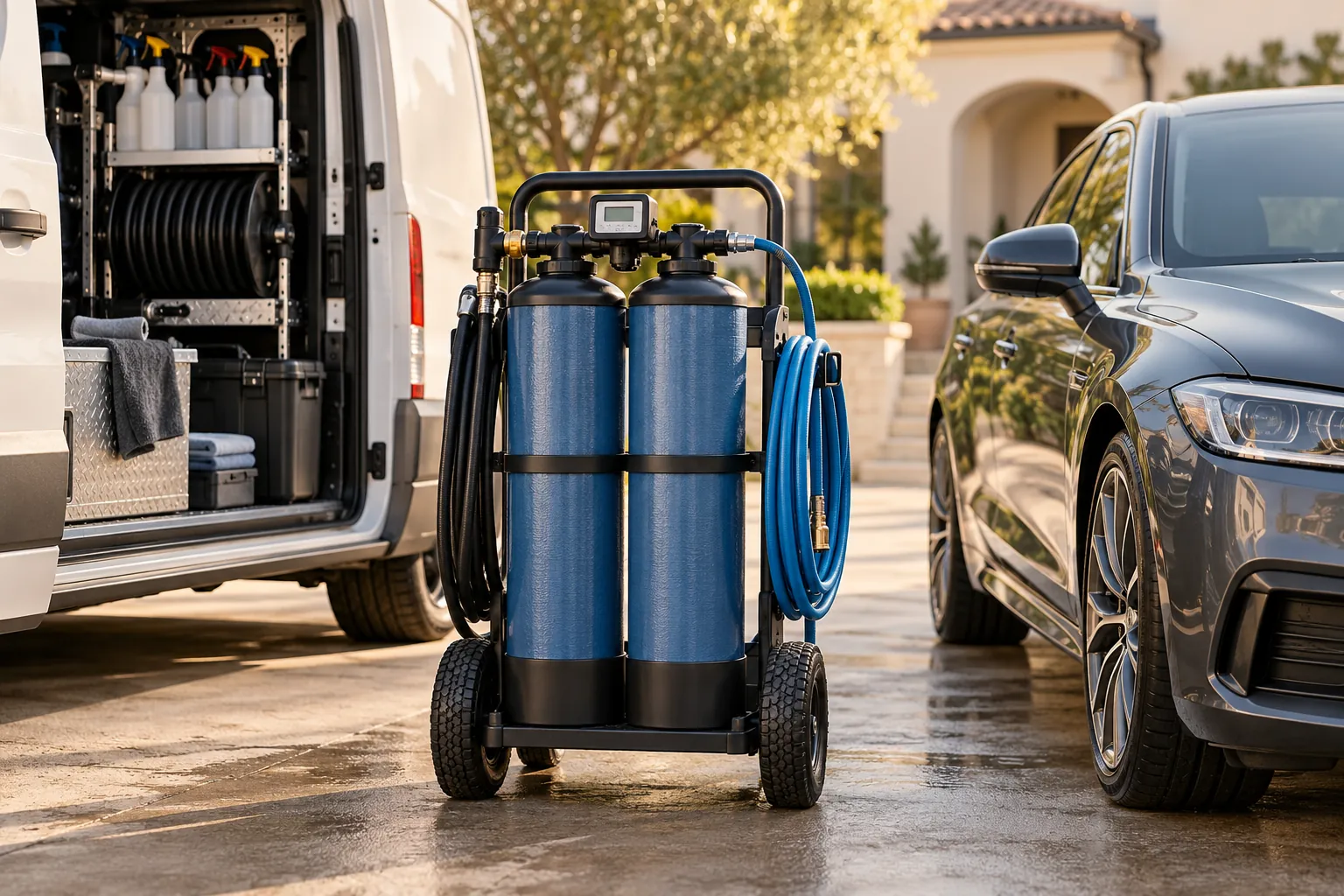
The CR Spotless system collection shows different equipment configurations. Verify the model’s requirements and capacity before designing your mobile setup. This guide does not recommend a particular brand or assume that every system is compatible with every pressure washer and source.
Add ownership and process costs
Consumables are only one part of the total. Include the system’s purchase or lease cost over a reasonable planning period, replacement parts, transport or installation changes, monitoring supplies, and the time required to maintain it. Account for water costs where the business pays them.
Use a consistent allocation method. A fictional $600 annual equipment allowance spread over 300 relevant vehicles adds $2 per vehicle. Spread over only 100 vehicles, it adds $6. Those are planning allocations, not accounting or tax instructions.
Keep cash flow distinct from cost allocation. Paying for a system today affects available cash immediately, even if your planning model spreads its cost across future jobs. If the purchase would crowd out essential working capital, a favorable per-car estimate does not by itself resolve that problem.
Compare time saved with time actually recoverable
Measure the full process before and after a controlled trial. Include setup, monitoring, resin handling, and any remaining drying or inspection work. A shorter final-rinse stage may not reduce the total appointment if another step still determines completion.
Suppose a fictional process saves eight minutes of active labor per vehicle. At an illustrative loaded labor cost of $30 per hour, that time equals $4. If the added consumable and allocated equipment cost is $5.20 per vehicle, the labor saving alone does not cover it. Other benefits would need separate evidence.
Labor time value 4
Consumables plus equipment allocation 5.2
Illustrative scenario. Values come from the assumptions explained in the article.
The value of owner time is real, but eight minutes saved on scattered appointments may not create another sale. Distinguish reduced effort, additional capacity, and actual cash savings. They can all matter, but they are not interchangeable benefits.
Include rework only when you can document it
If water-related rework is part of the business case, track it consistently before the change. Record the affected vehicle, observed issue, corrective time, and likely cause without automatically attributing every spot to the source water.
After the trial, compare similar services and conditions. A few favorable jobs do not establish a permanent percentage reduction. Keep the sample size visible and treat early results as preliminary. The business needs a useful decision, not a dramatic claim for a marketing graphic.
Our underquoted-detailing-job guide helps connect observed time with future estimates. Use measured process improvements to update the estimate model, rather than assuming a new tool fixes an existing pricing problem by itself.
Test the mobile setup before promising the service
Check space, transport security, connection compatibility, source access, and the full operating instructions. Confirm that the team can monitor the system as required and recognize when output no longer meets the specified condition. A system without a workable replacement process can become an unused expense.
Use the mobile-detailing site checklist to assess the location. Treated water does not remove site constraints around drainage, access, weather, or customer permission. Keep those decisions in the job plan.
Avoid promising “spot-free in every condition.” The actual vehicle condition, process, products, and environment still matter. Describe the service accurately and inspect the final result. A useful technology does not justify a guarantee broader than your evidence.
Can you compare two technicians fairly?
Use similar vehicle types, the same defined process, and comparable source conditions. Record setup and inspection time as well as rinse volume. A lower water number is not automatically better if the final result requires rework. Discuss the differences with the technicians and identify a repeatable method before turning the trial into a performance target. The measurement should improve the process rather than reward skipping a necessary step.
Run a ten-vehicle learning trial
Choose a representative set of jobs and record source, treated gallons, active time, and final inspection notes. Ten vehicles are a practical starting sample for learning, not a statistical proof of performance. Include different sizes or route conditions that matter to your operation.
Review the largest variation before buying more capacity. If one location sharply reduces yield, investigate that source within the system manufacturer’s guidance. If one technician uses twice the rinse volume, compare the process before assuming that the vehicle alone explains it.
Your next step is to measure one replacement cycle and a small group of actual rinses. Once you know usable yield and gallons per vehicle, the cost comparison becomes a business decision grounded in your route rather than a number borrowed from someone else’s setup.
Updated in 2026. Prepared by Clientory Studio with AI-assisted research and editorial review. Numerical scenarios are illustrations unless a source is named. Generated editorial imagery is illustrative, not a photograph of a Clientory customer project.