Pre-Black Friday Special on every Complete System: US$59 US$39 until Sunday, Nov 29 (US$59 from Nov 30). See the systems →
How to Protect Plants During House Washing
Plan plant protection before a house wash: inspect landscaping, check product labels, control exposure, and document the handoff with your customer.

Pressure Washing · United States
In this guide
A house-washing crew can deliver clean siding and still leave an unhappy customer if the planting bed below it is damaged. The problem often starts before any product reaches the wall: the estimate covers the building, while the landscaping is treated as something the technician will handle on arrival.
Plant protection belongs in the scope, schedule, and site briefing. It requires time, access to suitable water, a decision about movable items, and a way to stop work when conditions change. This guide focuses on that operational plan. It does not provide a chemical mixing recipe or promise that a particular precaution makes every plant safe.
Map the exposure before choosing the method
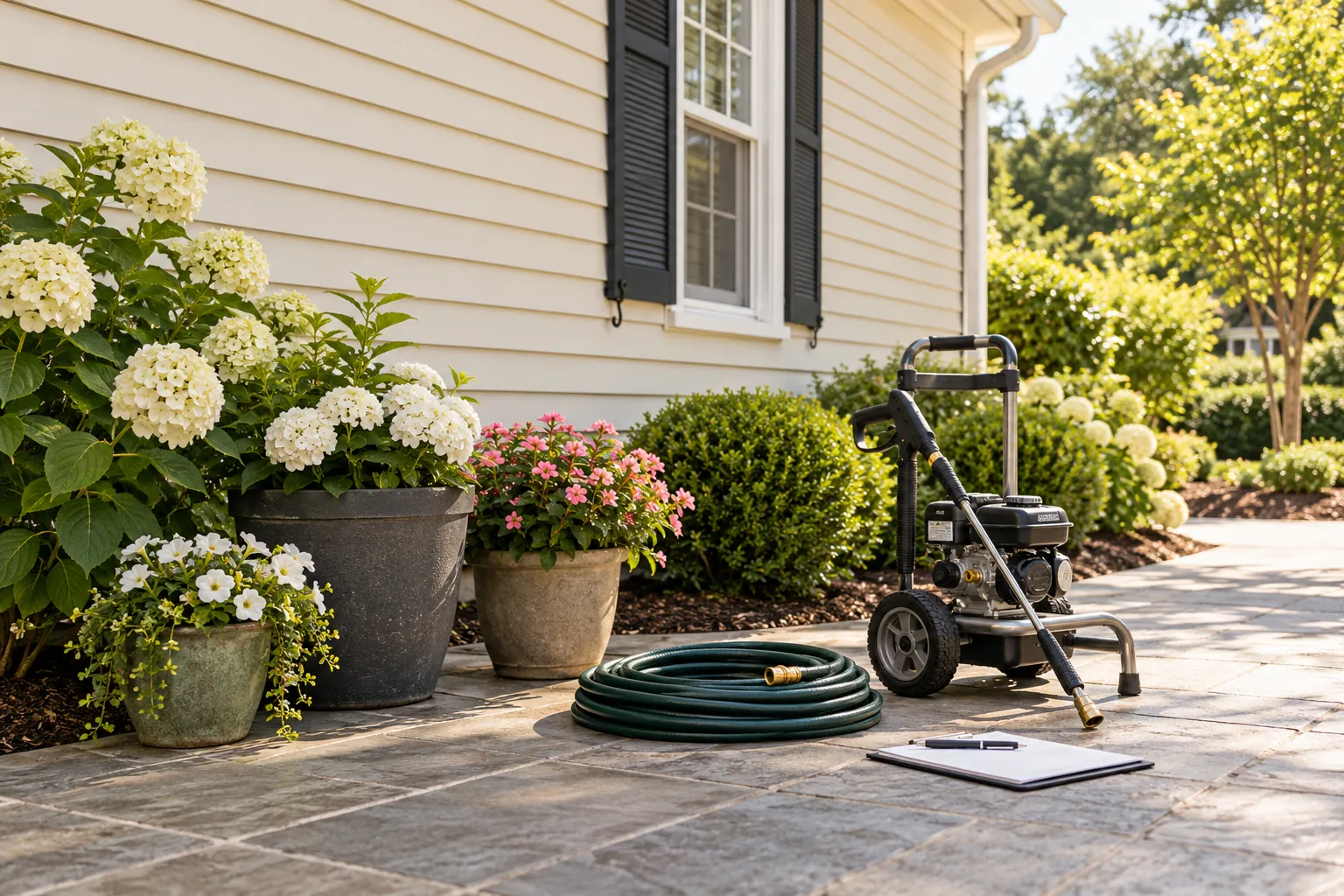
Walk the complete work area with the customer when possible. Look above, beside, and below the surfaces being cleaned. Include hanging baskets, containers, vegetable beds, new transplants, irrigation equipment, ponds, and planting areas around downspouts. A bed outside the direct spray path may still receive drainage.
Take clear overview photographs and closer views of existing discoloration, damaged leaves, or stressed planting. Describe what you can see without diagnosing a plant disease. The useful record says “brown leaf edges visible before service,” not “plant already dying.” Observations should be factual and dated.
Ask the customer which plants have special significance or recent treatment. A newly planted specimen may matter more to the owner than a large established hedge. Record the concern and assess whether your planned method is appropriate. Customer approval does not replace the contractor’s responsibility to choose a workable process.
- Inspect planting and drainage
- Verify product and equipment instructions
- Agree on protection and access
- Monitor exposure during work
- Review and document the handoff
Read the label before promising protection
The product label, safety data sheet, surface instructions, and equipment manual answer different questions. The label governs the product’s intended use and precautions. The safety data sheet adds handling and emergency information. The machine manual determines what the equipment can accept. Read the actual documents for the products and system you will use.
Do not borrow a dilution or application method from a contractor using a different formulation. Similar product names do not establish identical concentration, compatibility, or plant precautions. Keep the current product identity available to the crew rather than relying on an unlabeled container or a remembered recipe.
Simpson’s equipment FAQs illustrate why equipment compatibility must be checked separately: the manufacturer warns against running bleach through its pressure-washer pump. Professional chemical-delivery arrangements vary, so confirm your exact system rather than interpreting that warning as permission to improvise a workaround.
Clorox’s outdoor mold and mildew guidance includes precautions around nearby vegetation for the specified use. Treat manufacturer guidance as product-specific. It is not evidence that every house-wash mixture or every landscape can tolerate the same process.
Assign each protection task to a person
“We protect plants” is too vague for a crew instruction. State who moves containers, who checks the sensitive zone, who manages hoses, and who watches drainage. On a small job one technician may hold several roles, but the sequence still needs to leave enough attention for each task.
For larger or obstructed properties, plan how the operator and observer will communicate. The observer needs authority to call a stop when spray moves toward an unprotected area or conditions exceed the agreed method. A warning that cannot be heard over equipment is not an effective control.
| Task | Before work | During work | At handoff |
|---|---|---|---|
| Movable containers | Identify and agree on relocation | Keep outside exposure route | Return as agreed |
| Sensitive beds | Record condition and method | Monitor actual exposure | Review visible condition |
| Water access | Verify suitability and availability | Watch interruptions | Restore access setup |
| Drainage route | Identify destination | Check changing flow | Record unresolved concerns |
Avoid leaving plant protection until the final rinse. If a precaution is required before exposure, performing it afterward does not recreate the intended sequence. Put the relevant checkpoint before chemical application on the field brief.
Decide what can move and what needs a different plan
Relocating a small planter may be straightforward. Moving a heavy container, fragile trellis, or collection of valuable plants may require the owner or a specialist. Agree on responsibility before arrival. Do not assume the technician can safely lift everything that happens to sit beside the wall.
Covering is not automatically the correct answer. A cover can change heat and moisture conditions, interfere with monitoring, or redirect liquid. Follow the applicable guidance and consider weather, duration, ventilation, and the plant itself. If you cannot identify a suitable protection method, adjust the service area or refer the concern.
For edible plants, ponds, and other sensitive features, make a deliberate decision about whether work can proceed as proposed. Avoid broad claims such as “pet-safe,” “plant-safe,” or “eco-friendly” without support for the actual product, exposure, and use. Clear limitations are more credible than a reassuring phrase that does not describe a method.
Check water supply and the whole drainage path
Protection work may depend on reliable water as much as the cleaning does. Confirm the connection, access permission, and supply needed for your equipment and planned precautions. If supply becomes unreliable, pause and reassess instead of silently dropping the protection steps to finish the building.
Our customer water-flow checklist helps organize the supply check. Keep the landscaping requirements in the same job brief so the operator does not treat all available water as cleaning capacity.
Trace where water will go rather than assuming it stays directly below the wall. Slopes, paving, gutters, and low spots can move it toward planting or other sensitive areas. Applicable wastewater and discharge requirements also matter; plant protection does not authorize releasing wash water wherever it is convenient.
Build the time into the estimate
Use a separate internal allowance for inspection, setup, monitoring, and restoration. The customer can receive a simple overall scope, but the crew’s production plan should not hide this work inside an optimistic spraying time.
Consider a fictional property requiring 15 minutes for the walkthrough, 20 minutes for agreed protection setup, and 10 minutes for restoration and review. That is 45 minutes before any additional monitoring labor. If a second worker monitors for 30 minutes, the job uses another half labor-hour even though the elapsed visit does not increase by the same amount.
These figures are an illustration, not an industry allowance. Measure your actual jobs by exposure complexity. A small house with dense planting can need more preparation than a larger building with open access. Pricing only by wall area can miss that difference.
Give the customer a precise preparation message
Ask for actions the customer can reasonably complete, with a deadline and a clear alternative if they cannot. For example: “Please move the three small pots beside the back steps to the agreed patio location before our arrival. We will review the fixed planting bed with you before starting that wall.”
Avoid making the customer responsible for a technical protection method they do not understand. The owner can identify valued plants and provide access. The contractor should still verify the site and decide whether the work can proceed safely within the agreed scope.
Use the pressure-washing customer preparation guide for the broader arrival checklist. Add the property’s specific planting instructions rather than sending a generic paragraph that mentions none of the features actually present.
Respond calmly if a concern appears
Stop the affected work, prevent further exposure where safe, and follow the product’s applicable response instructions. Record the time, location, product identity, and visible condition. Do not improvise a chemical “neutralizer,” mix products, or promise that additional treatment will reverse an uncertain effect.
Tell the customer what you observed, what work has paused, and when you will provide the next update. Where an assessment is needed, involve a qualified landscape professional or the appropriate product support contact. Keep the record factual; it should support investigation rather than assign blame prematurely.
Arrange a defined follow-up when appropriate. An immediate photograph cannot establish every later outcome. Equally, a later complaint should be evaluated against the actual work record, weather, and site circumstances rather than dismissed because the handoff looked normal.
What should a substitute technician receive?
Provide the marked site overview, current product instructions, assigned protection tasks, and the stop-work contact before arrival.
Make the next job easier to brief
Before the next house wash, add one marked site overview showing sensitive areas and drainage direction. Then have the assigned technician explain the protection sequence back to you. If the plan cannot be explained clearly before setup, resolve the missing decision before work begins.
Updated in 2026. Prepared by Clientory Studio with AI-assisted research and editorial review. Numerical scenarios are illustrations unless a source is named. Generated editorial imagery is illustrative, not a photograph of a Clientory customer project.